Table Saw vs Circular Saw: Which Should You Buy First?
A detailed comparison of table saws and circular saws to help you decide which one to buy first. Covers pros, cons, use cases, safety, and top picks for each.
 Build Coded Editorial
 The First Power Saw Decision
If you’re setting up a woodworking shop and can only afford one saw, this is the question that keeps you up at night: table saw or circular saw? Both can rip lumber, crosscut boards, and handle sheet goods. Both are foundational tools. But they work in fundamentally different ways, and the right choice depends on what you plan to build, where you plan to build it, and how much you want to spend.
I’ve used both extensively for over a decade. Here’s the honest breakdown.
What Each Saw Does Best
The Circular Saw
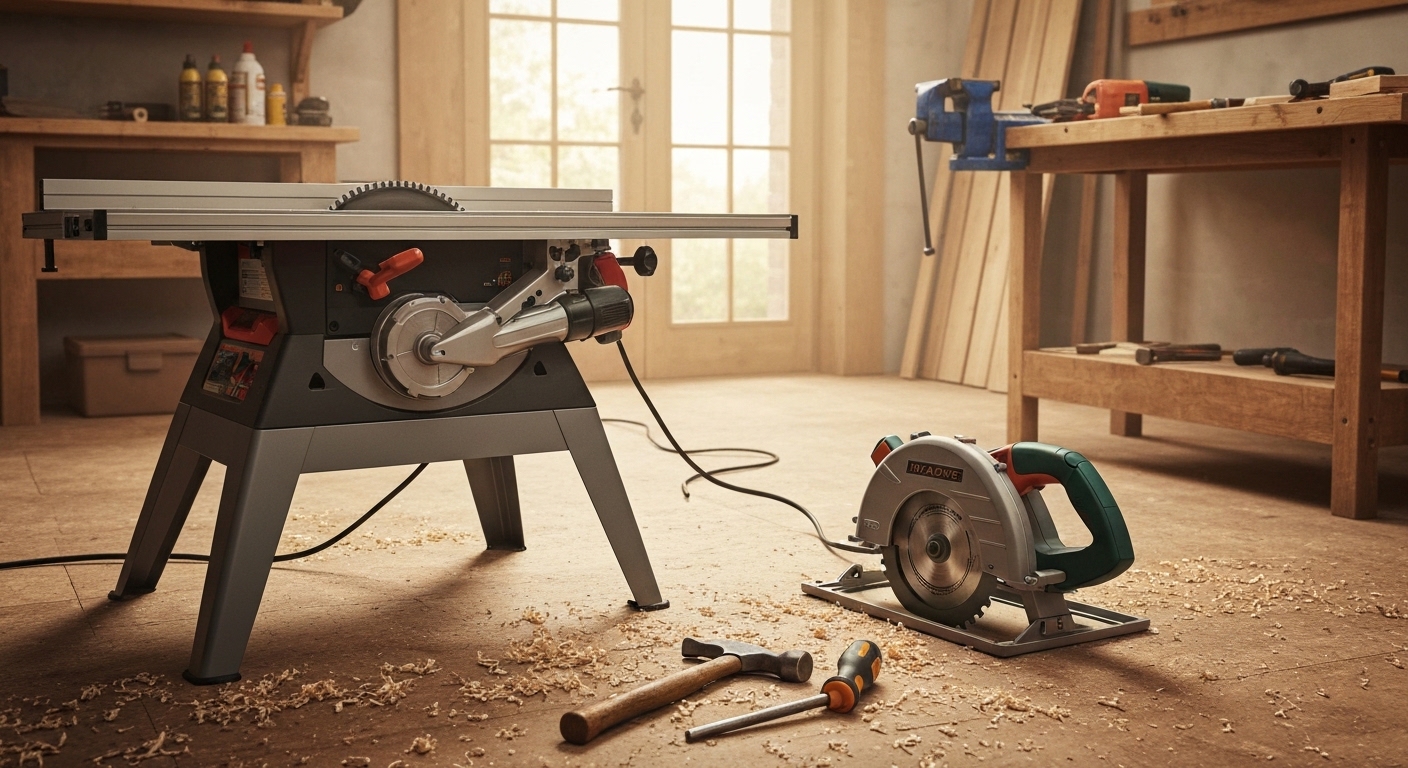
A circular saw is a handheld power tool with a spinning blade that you push through the wood. It’s portable, relatively affordable, and surprisingly versatile when paired with the right guides and jigs.
Strengths:
- Extremely portable — take it to the job site, the backyard, or a friend’s garage
- Low cost of entry — a quality model starts around $60-100
- Handles sheet goods (plywood, MDF) better than most table saws because the sheet stays flat on sawhorses and the saw moves across it
- Can make rip cuts, crosscuts, bevel cuts, and even plunge cuts
- Small footprint — stores on a shelf
Weaknesses:
- Accuracy depends heavily on your technique and guides
- Ripping long boards to consistent width is difficult without a track system
- Repetitive identical cuts (like cutting 20 shelf pieces) are slow and tedious
- No built-in fence for repeatable cuts
- Blade is exposed and guard management requires attention
The Table Saw
A table saw is a stationary tool with a blade that protrudes up through a flat table surface. You push the wood through the blade, guided by a fence (for rip cuts) or a miter gauge (for crosscuts).
Strengths:
- Unmatched accuracy and repeatability — set the fence once, cut 50 identical pieces
- Ripping boards to width is fast and precise
- Can cut dadoes, rabbets, and grooves with a dado blade set
- The flat table surface supports the wood throughout the cut
- A good fence makes setup almost foolproof
Weaknesses:
- Takes up significant shop space, even a job-site model
- Not portable (contractor and cabinet saws are very heavy)
- Cutting full sheets of plywood on a table saw is awkward and sometimes dangerous without outfeed support
- Higher cost of entry — decent job-site models start around $300-400
- Kickback risk is real and demands respect
Head-to-Head Comparison
Accuracy
Winner: Table saw. The built-in fence and miter gauge give you repeatable precision with minimal effort. A circular saw can achieve similar accuracy, but only with a good track system or straight-edge guide, and it requires more setup time per cut.
That said, a circular saw track guide closes the gap significantly. If you’re buying a circular saw, budget for a track.
Versatility
Winner: Circular saw (slightly). A circular saw can make every cut a table saw can, plus it handles plunge cuts and works on job sites where a table saw can’t go. The table saw wins on joinery cuts (dadoes, rabbets) with a dado blade, but a router can fill that gap if needed.
Safety
Winner: Neither — both demand respect. Table saws cause more serious injuries statistically, primarily from kickback. Circular saws cause more minor injuries from blade contact. Both tools are safe when used correctly with proper guards, push sticks, and technique.
Safety warning: If you buy a table saw, learn about kickback before you make a single cut. Understand why it happens, how the riving knife prevents it, and never remove the riving knife. A SawStop table saw adds flesh-sensing technology that stops the blade on contact, but it comes at a premium price.
Cost
Winner: Circular saw. A good circular saw costs $60-150. A comparable-quality table saw costs $300-700 for a job-site model, $500-1500 for a contractor saw, and $1500+ for a cabinet saw. The circular saw is the clear budget winner.
Space Requirements
Winner: Circular saw. A circular saw fits in a toolbox. A job-site table saw needs a 4x4 foot area minimum, plus infeed and outfeed space. If you’re working in a one-car garage or a small basement, the table saw may not be practical.
Repeatability
Winner: Table saw. When you need to cut 30 pieces to exactly the same width, a table saw with its fence is unbeatable. Set it, lock it, cut. A circular saw requires marking each cut or building a dedicated jig, and even then, it’s slower.
When to Buy a Circular Saw First
Buy a circular saw first if:
- You’re on a tight budget. You can get a great circular saw and a track guide for under $200 and start building real projects immediately.
- You work in a small space. No room for a table saw? No problem. A circular saw and a pair of sawhorses take up almost no space.
- You do mostly construction or outdoor projects. Decks, fences, sheds, and framing work are circular saw territory.
- You work with a lot of sheet goods. Breaking down plywood is genuinely easier with a circular saw on sawhorses than wrestling full sheets across a table saw.
- You’re not sure you’ll stick with woodworking. A circular saw is useful even if you never build furniture. It’s a general-purpose tool.
Top Circular Saw Picks
Best overall: DEWALT DWE575SB 7-1/4” Circular Saw — Lightweight (8.8 lbs), powerful 15-amp motor, excellent dust blower keeps your cut line visible. Around $100-130.
Best value: SKIL 5280-01 7-1/4” Circular Saw — A reliable workhorse at around $50-60. Not as refined as the DEWALT, but it cuts straight and the laser guide is helpful.
Best track system: Makita SP6000J Track Saw — This is technically a track saw, not a circular saw, but if precision is your priority, this is the ultimate portable cutting system. Around $350-400 with a track.
When to Buy a Table Saw First
Buy a table saw first if:
- You want to build furniture. Ripping boards to consistent widths is a furniture-making fundamental, and a table saw does it better than anything else.
- You have adequate shop space. You need room for the saw plus several feet of clearance on all sides for safe material handling.
- You value precision and repeatability. If you know you’ll be making multiple identical cuts regularly, a table saw saves hours.
- You plan to do joinery. With a dado blade, a table saw cuts dadoes, rabbets, and grooves that are essential for cabinet and bookshelf construction.
- You’ve already used a circular saw and want to upgrade your capabilities.
Top Table Saw Picks
Best job-site saw: DEWALT DWE7491RS 10” Table Saw with Rolling Stand — The gold standard for portable table saws. Accurate fence, 32-1/2” rip capacity, and the rolling stand makes it easy to move and store. Around $500-600.
Best value: Ridgid R4518 10” Table Saw with Stand — Very competitive with the DEWALT at a lower price point. The fence isn’t quite as smooth, but the lifetime warranty makes up for it. Around $350-400.
Best safety: SawStop Jobsite Saw JSS-MCA — The only portable table saw with flesh-detection technology. If the blade touches skin, it stops in milliseconds. Worth the premium if safety is your top concern. Around $900-1000.
Best full-size: SawStop Contractor Saw CNS175 — If you have the space and budget, this is a buy-it-for-life saw. Cabinet-quality cuts with flesh-detection safety. Around $1500-2000.
The “Both” Strategy
Here’s what I actually recommend to most beginners: buy the circular saw first, then add a table saw when a project demands it.
Start with a good circular saw and a straight-edge guide. Build a few projects. Learn what cuts are easy with a circular saw and which ones make you wish you had a table saw. When that frustration hits — usually around the time you’re trying to rip eight identical shelf pieces — that’s when you’ll know exactly what table saw features matter to you.
This approach also spreads out the cost. A $100 circular saw today and a $500 table saw in six months is easier to stomach than $600 all at once.
What About a Miter Saw?
A miter saw is a third option that sometimes enters this conversation. It excels at precise crosscuts and angled cuts in narrow boards (think trim, molding, and framing lumber). But it can’t rip boards to width at all, which makes it a poor choice as your only saw.
If you’re doing a lot of trim work, a miter saw is valuable. But for general woodworking, it’s a supporting player, not a starter.
The Verdict
For most beginners, the circular saw is the smarter first purchase. It costs less, takes up less space, and handles a wider range of tasks outside the shop. Pair it with a good track or straight-edge guide, and you can build furniture-quality projects right from the start.
Buy a table saw first only if you know you want to build furniture, you have dedicated shop space, and you can afford a quality model (the DEWALT DWE7491RS or better). A cheap table saw with a bad fence is worse than a good circular saw with a track — don’t compromise on fence quality.
Whichever you choose, learn it thoroughly before moving on. Master the tool you have, and you’ll know exactly when you need the next one.