Why Natural Methods First
Before you reach for a can of chemical spray, consider this: most ant infestations in homes can be resolved with natural methods that are safer for kids, pets, and your indoor air quality. Chemical sprays kill the ants you can see, but they rarely solve the actual problem — the colony that is sending them.
Natural methods, done correctly, can eliminate entire colonies. Some natural baits (like borax-based ones) work the same way professional baits do: foraging ants carry the toxic substance back to the colony and share it, killing the queen and the whole nest over a few days. That is more effective than killing surface scouts, who get replaced within hours.
That said, I will be honest about the limitations too. Some infestations — particularly carpenter ants doing structural damage or large-scale invasions — genuinely need professional treatment. I will tell you when you have crossed that line.
Step 1: Identify What You Are Dealing With
Not all ants are the same, and the species you are dealing with determines which approach works best. Here are the most common household invaders:
Odorous House Ants (the most common)
- Size: Tiny, about 1/16 to 1/8 inch
- Color: Dark brown to black
- Identifying feature: Crush one and smell it. If it smells like rotten coconut or blue cheese, you have odorous house ants. It is an oddly distinctive smell.
- What they want: Sugar and grease. They come inside looking for food and water, especially in spring and fall.
- Good news: These respond very well to natural baits and are not structurally damaging.
Carpenter Ants
- Size: Large, 1/4 to 1/2 inch
- Color: Usually black, sometimes reddish-brown
- Identifying feature: Their size is the giveaway. Also look for small piles of sawdust-like frass near wood surfaces.
- What they want: They do not eat wood — they excavate it to build nests. They are attracted to moist or damaged wood.
- Concern level: High. Carpenter ants cause structural damage similar to termites. If you find them, natural methods may not be sufficient.
Pavement Ants
- Size: Small, about 1/8 inch
- Color: Dark brown to black
- Identifying feature: They nest in cracks in driveways, sidewalks, and foundations. You will often see small mounds of sand or dirt at pavement cracks.
- What they want: They eat almost anything — sweets, grease, seeds, other insects.
- Good news: They rarely nest inside the home. Sealing entry points usually solves the problem.
Fire Ants
- Size: Small to medium, 1/16 to 1/4 inch
- Color: Reddish-brown
- Identifying feature: Aggressive behavior and painful stings. Large visible mounds in the yard.
- What they want: They are primarily outdoor ants but will enter homes for food.
- Concern level: Their stings are medically significant, especially for allergic individuals. Professional treatment of outdoor mounds is often justified.
Pharaoh Ants
- Size: Very tiny, about 1/16 inch
- Color: Yellowish to light brown, almost translucent
- Identifying feature: Extremely small, tend to infest warm, humid areas near food and water.
- Concern level: These are notoriously difficult to eliminate. They have multiple queens per colony and will “bud” — splitting into new colonies when disturbed. Standard sprays make them worse. Baiting is the only effective approach, and professional help is often needed.
Step 2: Understand Why They Are in Your House
Ants do not invade your home randomly. They are there for one or more of three reasons:
-
Food. Crumbs, spills, pet food, fruit left on counters, grease near the stove, honey or syrup drips — all of these draw scout ants. Once a scout finds food, it lays a pheromone trail back to the colony, and the parade begins.
-
Water. During dry spells, ants come inside looking for moisture. Leaky pipes, condensation under sinks, pet water bowls, and damp bathrooms are common attractants.
-
Shelter. In extreme heat, cold, or heavy rain, ants move indoors for a more comfortable environment. This is often seasonal — you see them every spring or every time it rains heavily.
Understanding the motivation helps you choose the right response. If they want food, deny them food. If they want water, fix the moisture issue. If they want shelter, seal the entry points.
Step 3: Natural Deterrents and Treatments
These methods are listed in order of effectiveness, based on what actually works in practice rather than what sounds good on social media.
Borax Bait Stations (Most Effective)
Borax (sodium borate) is a naturally occurring mineral that is lethal to ants but takes effect slowly enough that foraging ants carry it back to the colony and share it through trophallaxis (mouth-to-mouth feeding). This is the same mechanism used in commercial bait stations — you are just making it yourself.
Sugar bait recipe (for sugar-loving ants):
- 1/2 cup sugar
- 1-1/2 tablespoons borax
- 1-1/2 cups warm water
Mix until dissolved. Soak cotton balls in the solution and place them on small pieces of cardboard or in shallow lids near ant trails. Replace every 2-3 days.
Grease bait recipe (for grease-loving ants):
- 2 tablespoons peanut butter
- 1/2 tablespoon borax
- 1 tablespoon honey
Mix thoroughly. Place small amounts on cardboard squares near ant trails.
Important safety note: Borax is low-toxicity for humans and pets in small amounts, but it should not be ingested. Keep bait stations out of reach of children and pets. Place them behind appliances, inside cabinets, or in other locations where kids and animals cannot access them. If you have curious pets that get into everything, use enclosed bait stations — small containers with holes big enough for ants but too small for paws or fingers.
How it works: Ants find the bait, eat it, and carry it back to the nest. It takes 24-72 hours for the borax to kill them — slow enough that they share it with nestmates and the queen. You may see more ants initially as word spreads about the food source. This is a good sign. Resist the urge to spray them — let them take the bait home. The colony should be significantly reduced or eliminated within 1-2 weeks.
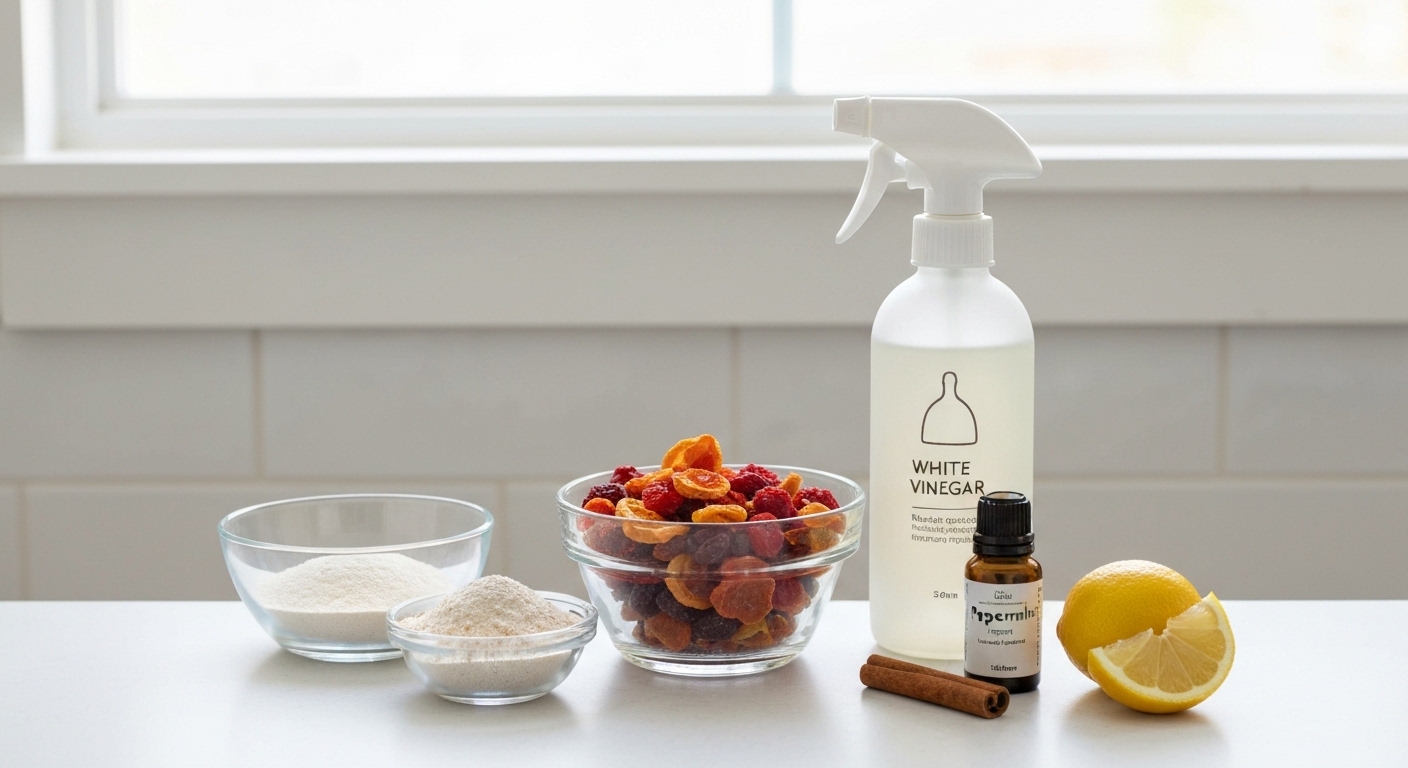
Diatomaceous Earth (DE)
Food-grade diatomaceous earth is a fine powder made from fossilized algae. Under a microscope, the particles have razor-sharp edges that cut through an insect’s exoskeleton, causing dehydration and death. It is completely non-toxic to humans and pets (food-grade only — do not use pool-grade DE, which is chemically treated).
How to use it:
- Apply a thin layer along ant trails, entry points, around the foundation, and in cracks and crevices where ants travel.
- Use a squeeze bottle or powder duster for precise application.
- Reapply after rain or if the powder gets wet — DE loses its effectiveness when damp.
- Apply it in wall voids, behind outlet covers, and under appliances where ants nest.
Limitations: DE only works on ants that walk through it. It is a barrier, not a bait — it does not eliminate the colony unless the nest is directly treated. Use it in combination with bait stations for best results.
Pro tip: Apply DE on a dry day and in dry locations. The powder needs to stay dry to work. In humid environments like bathrooms, it may not be effective.
White Vinegar Solution
A 50/50 solution of white vinegar and water disrupts the pheromone trails that ants use to navigate. Spray it directly on ant trails, entry points, countertops, and around windows and doors.
What it does: The vinegar destroys the chemical trail, causing scout ants to lose their way. It also kills ants on contact.
What it does not do: Eliminate the colony. This is a short-term disruption tool, not a long-term solution. Use it to clean up visible trails while your bait stations do the real work.
How to use it: Spray generously along trails and wipe surfaces. Repeat daily until ant activity stops. The vinegar smell dissipates within 30 minutes.
Peppermint Essential Oil
Peppermint oil is a strong ant repellent. They genuinely dislike it and will avoid areas where it has been applied.
How to use it:
- Add 10-15 drops of peppermint essential oil to a spray bottle with water (about 1 cup).
- Spray around entry points, windowsills, door frames, and along baseboards.
- Re-apply every few days as the scent fades.
- You can also soak cotton balls with peppermint oil and place them near entry points.
Effectiveness: Peppermint works as a deterrent — it keeps ants from crossing a treated barrier. It does not kill them or address the colony. Think of it as a “keep out” sign, not a solution on its own.
Other essential oils that repel ants: Tea tree oil, lemon eucalyptus oil, and clove oil all have some repellent effect. Peppermint is the most consistently effective in my experience.
Cinnamon
Ground cinnamon and cinnamon essential oil both repel ants. Sprinkle ground cinnamon across entry points and along windowsills. For a stronger effect, use cinnamon essential oil the same way as peppermint oil (10-15 drops per cup of water).
Why it works: The compounds in cinnamon — particularly cinnamaldehyde — are irritating to ants and mask their pheromone trails. Some studies suggest cinnamon oil can kill ants on contact, though it is more reliably a deterrent.
Best use: Sprinkle ground cinnamon in areas where you do not want ants but where borax baits are not practical — like around pet food bowls or on a child’s windowsill.
Lemon Juice and Citrus Peels
The acidity of lemon juice disrupts pheromone trails, and the limonene in citrus peels is a natural insecticide. Spray lemon juice along trails, or place citrus peels near entry points.
Honest assessment: This is the weakest method on the list. It provides temporary disruption and smells nice, but it will not solve a real ant problem on its own. Use it as a supplementary tactic alongside baiting.
Step 4: Seal Entry Points
This is where most people skip, and it is arguably the most important step for long-term ant prevention. If ants cannot get in, you do not need to worry about baiting or deterring them.
Common entry points to check and seal:
- Window frames and door frames. Run a bead of silicone caulk along any gaps between the frame and the wall. Pay special attention to the bottom of door frames.
- Where pipes and wires enter the house. Gaps around plumbing under sinks, electrical conduit entering the wall, and cable/internet entry points are highways for ants. Seal with caulk, expanding foam, or steel wool.
- Foundation cracks. Inspect the exterior foundation at ground level. Fill cracks with hydraulic cement or masonry caulk.
- Gaps around outlets and switch plates on exterior walls. Remove the cover plate and look for gaps around the electrical box. Seal with caulk or install foam gasket inserts (sold specifically for this purpose).
- Where the siding meets the foundation. This junction is often a continuous gap that runs the entire perimeter of the house. Seal it with exterior-rated caulk.
- Under doors. If daylight is visible under your exterior doors, install or replace the door sweep.
Pro tip: Follow the ant trail backward from inside your house to find their specific entry point. They usually have one main entry, and sealing it cuts off the entire parade. Watch carefully — they can enter through cracks as small as 1/16 inch.
Step 5: Eliminate Attractants
Make your home uninteresting to scout ants:
- Clean up food immediately. Wipe counters, sweep floors, and do not leave dirty dishes in the sink overnight. Even a few crumbs are a buffet for ants.
- Store food in sealed containers. Open bags of sugar, cereal, and flour are ant magnets. Transfer to glass or plastic containers with tight lids.
- Manage pet food. Do not leave pet food out all day. Feed your pets on a schedule and pick up bowls when they are done. If you must leave food out, place the bowl inside a shallow dish of water — ants will not cross the water moat.
- Take out trash regularly. A full kitchen trash can with food waste is an open invitation. Use a trash can with a lid and empty it daily.
- Fix moisture issues. Repair leaky faucets, clear clogged drains, and address any condensation problems. A single dripping pipe under the kitchen sink provides all the water a colony needs.
- Clean sticky residue. Jelly jars, honey bottles, syrup dispensers, and soda cans with residue on the outside are surprisingly effective ant attractors. Wipe them down.
Step 6: Outdoor Prevention
The colony lives outside. Treating the outdoor environment reduces the population that tries to get inside.
- Clear vegetation away from the house. Tree branches and shrubs touching the house are bridges for ants. Trim everything back at least 12 inches from the exterior walls.
- Move mulch away from the foundation. Mulch provides moist, sheltered habitat perfect for ant colonies. Keep a 12-inch gap between mulch beds and your foundation, or switch to gravel or stone near the house.
- Treat ant mounds in the yard. For pavement ants and other ground-nesting species, pour boiling water directly into the mound opening. It takes 2-3 treatments over a few days, but it is effective. For fire ant mounds, this method works but be cautious of the splash — stand back.
- Apply diatomaceous earth around the foundation perimeter. A 2-3 inch band of DE along the base of your house creates a barrier that kills ants before they reach entry points. Reapply after rain.
- Address moisture near the foundation. Make sure gutters drain away from the house, grading slopes away from the foundation, and there is no standing water near the exterior walls.
When Natural Methods Are Not Enough
Be realistic about when to escalate:
Call a professional if:
- You have carpenter ants. The structural damage they cause is real and can be significant. A professional can locate the nest (often inside walls) and treat it directly. Natural methods rarely reach carpenter ant nests because they are inside the wood of your home.
- You have pharaoh ants. These tiny ants have multiple queens and bud into new colonies when disturbed. Spraying them — even natural sprays — makes the problem worse. Professional baiting programs are specifically designed for pharaoh ant biology.
- The infestation persists after 2-3 weeks of baiting. If you have been running bait stations for two weeks and ant activity has not decreased, the colony may be larger than a DIY approach can handle, or you may be dealing with a species that is not attracted to your bait type.
- You see ants in unusual locations like coming out of electrical outlets, from behind baseboards in multiple rooms, or inside appliances. This suggests nesting inside the home, which is harder to treat from the outside.
- Anyone in the household has severe ant allergies or you are dealing with fire ants inside the home.
What a professional does differently: Professionals use commercial-grade bait systems with precisely calibrated active ingredients, they can identify species accurately, they know where to look for nests inside wall cavities, and they can apply non-repellent liquid treatments around the exterior that ants walk through unknowingly and carry back to the colony. The cost is typically $150-300 for a one-time treatment and $200-400 for quarterly prevention service.
A Practical Action Plan
Here is the sequence I recommend for most ant invasions:
Day 1:
- Identify the ant species (use the descriptions above or take a photo and search online)
- Follow the trail to find the entry point
- Clean up all food sources and wipe down surfaces with vinegar solution
- Set out borax bait stations near the trail
- Apply diatomaceous earth at the entry point
Day 2-3:
- Do not disturb the ant trail — let them find and take the bait
- You may see increased ant activity as more workers discover the bait. This is normal and means the plan is working.
- Continue wiping down surfaces with vinegar after ants have had time to visit the bait
Day 4-7:
- Activity should be noticeably decreasing
- Seal the entry point with caulk once ant traffic has significantly reduced
- Apply peppermint oil spray as a deterrent along former trails
Week 2:
- Activity should be minimal to zero
- Remove bait stations if no ants remain
- Complete your entry point sealing project around the house
- Apply DE around the exterior foundation
If activity increases or does not decrease by Day 7, reassess. You may need different bait (switch between sugar and grease baits), more bait stations, or professional help.
Common Mistakes
- Spraying and killing visible ants instead of baiting. Every ant you spray-kill is an ant that did not carry bait back to the colony. Killing scouts feels satisfying but is counterproductive to colony elimination.
- Using too much borax in bait. If the concentration is too high, ants die before returning to the colony. The recipes above use the right ratio — do not double the borax thinking more is better.
- Giving up too early. Borax bait takes 1-2 weeks to wipe out a colony. If you pull the bait after 3 days because “it is not working,” you stopped the process before it could finish.
- Sealing entry points while ants are still active inside. Seal them in and they will find new routes. Eliminate the indoor population first, then seal.
- Ignoring outdoor colonies. If you only treat indoors, the outdoor colony keeps sending new scouts. Address both the indoor symptoms and the outdoor source.
The Bottom Line
Most household ant problems are solvable with borax bait, diatomaceous earth, entry point sealing, and basic sanitation. These methods are safe, cheap, and — when done patiently — genuinely effective. The key is understanding that you are not trying to kill individual ants. You are using those ants as delivery vehicles to poison the colony they came from. Give the process time, keep your kitchen clean, seal the cracks, and the ants will be gone within two weeks. And if they are not, that is when you pick up the phone and call a professional without guilt — you gave it an honest effort.