Why the Right Table Saw Matters for Beginners
A table saw is the single most important machine in a woodshop. It rips, it crosscuts, it cuts joinery, it dimensions sheet goods, and with the right jigs it will do about ninety percent of the cutting you need. Pick the wrong one and you fight it every time you turn it on. Pick the right one and it disappears into your workflow, which is exactly what a good tool should do.
Beginners get this decision wrong in two directions. Some people buy the cheapest saw on the shelf, and three months later they’re frustrated with a fence that won’t stay square and a blade that wanders. Others overspend on a 5 HP cabinet saw when a $600 contractor saw would have covered every project they actually build. The goal isn’t the most expensive saw or the cheapest one. It’s the saw that matches your space, your budget, and the kind of work you’ll actually do.
This guide breaks down seven saws across four tiers: jobsite, compact, contractor, hybrid, and cabinet. Each one is a legitimate pick for the right person.
What to Look For in a Beginner Table Saw
Before you compare specific models, understand the specs that matter.
Motor and Power
Jobsite saws run on universal motors rated in amps, usually 15. They are loud, but they will rip 4/4 hardwood all day. Contractor and hybrid saws typically have 1.75 HP induction motors. Cabinet saws run 3 to 5 HP induction motors on 240V. More power means cleaner cuts in thick hardwood, less bogging, and longer motor life.
The Fence
A fence is the single most important part of a table saw. A saw with a great motor and a bad fence is unusable. Look for a Biesemeyer-style T-square fence that locks dead parallel to the blade every time. Fences on sub-$400 saws are often the weakest link. Fences on hybrid and cabinet saws are usually excellent.
Accuracy
Your saw should cut within 0.005 inches of square over the full rip width. You can dial in most saws with a few hours of tuning, but some budget saws will never hold an adjustment.
Dust Collection
Jobsite saws leak dust badly. Cabinet saws capture 80 percent or more with a 4-inch port. This matters for your lungs and your shop cleanliness, not just your floor.
Safety Features
Look for a riving knife (not just a splitter), a working blade guard, anti-kickback pawls, and if your budget allows, flesh-detection technology like SawStop’s brake system.
Tier 1: Jobsite Saws ($300 to $700)
These are the right pick for apartments, garages where the car still needs to fit, and anyone who needs to move the saw around. They give up some accuracy and dust collection for portability.
1. DEWALT DWE7491RS (~$649)
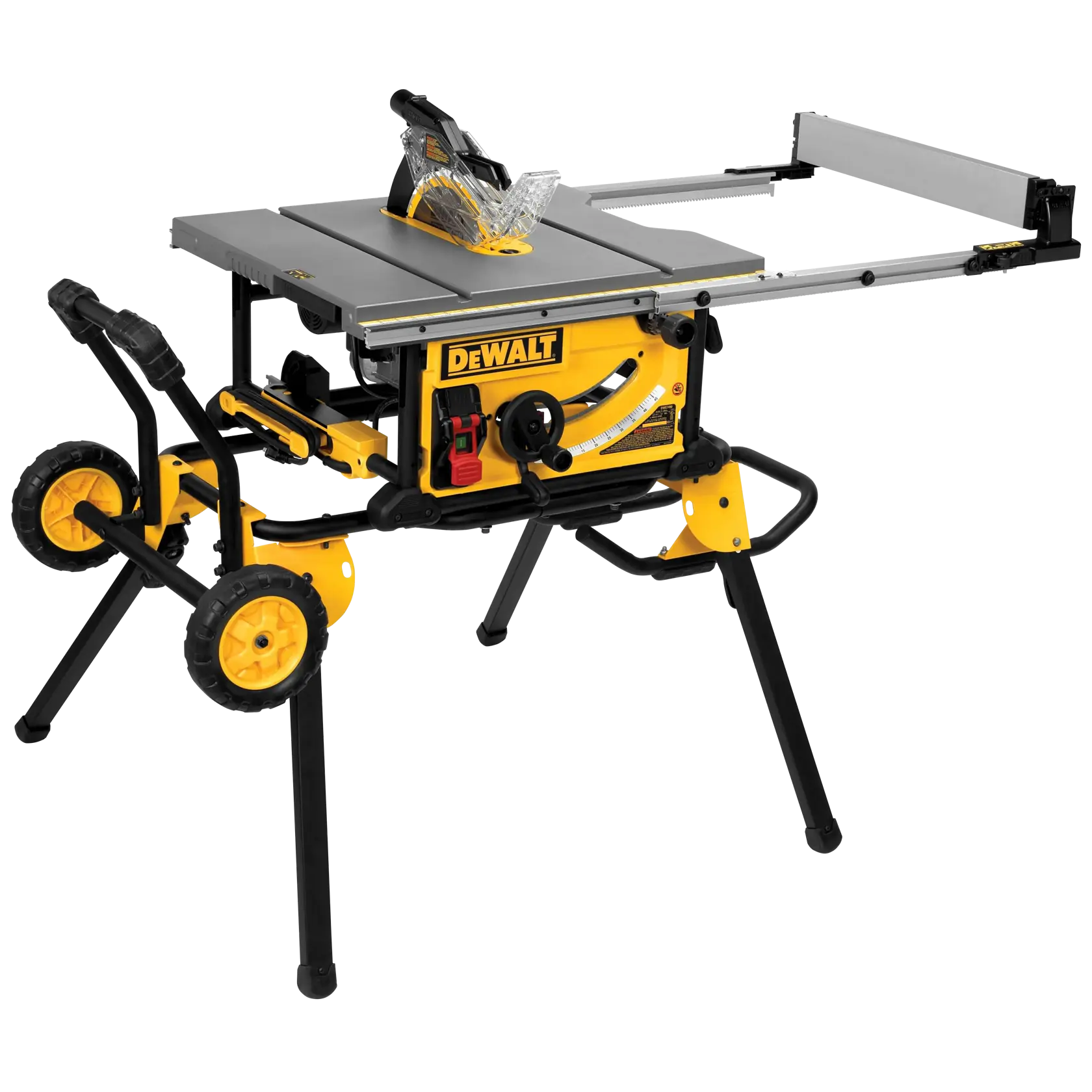
The DEWALT DWE7491RS is the jobsite saw I recommend most often to beginners. It has a 15-amp motor, a 32.5-inch rip capacity, and a rolling stand that folds for storage. The rack-and-pinion fence is genuinely good. Not cabinet-saw good, but good enough that you won’t fight it on most cuts. It takes up about 2 square feet folded up and rolls like a suitcase.
Weaknesses: universal motor is loud, dust collection is weak without a shop vac connection, and the 10-inch blade combined with the shallow table limits you on thicker joinery cuts. For a first saw in a tight space, it is hard to beat.
2. Bosch 4100XC-10 (~$699)
The Bosch 4100XC-10 is the main competitor to the DEWALT. It has a slightly smoother fence, a gravity-rise stand that some people prefer, and the same basic 15-amp, 10-inch format. Rip capacity is 30 inches. Dust port is 2.5 inches which is workable with a good shop vac.
Get this one if you like the gravity-rise stand, which deploys faster than the DEWALT’s rolling frame. The cut quality and accuracy are essentially identical.
Tier 2: Contractor Saws ($700 to $1200)
Contractor saws split the difference between portability and shop-grade accuracy. Heavier than jobsite saws, but still movable with a mobile base. Better fences, bigger tables, and you start getting into induction motors, which means quieter, longer-lived machines.
3. SawStop CTS (~$999)
The SawStop Compact Table Saw put flesh-detection technology into the jobsite format. The saw senses contact with skin and fires a brake that stops the blade in 5 milliseconds. If you’re building a home shop and you have a family, this feature alone is worth the price of admission. Table insert and brake cartridge need replacement after a trigger, but the alternative is a trip to the emergency room.
Accuracy is very good. Fence is solid. The 15-amp motor handles 4/4 hardwood without complaint. If I were buying my first table saw today and could stretch to $1000, this is where I’d put my money.
Tier 3: Hybrid Saws ($1000 to $1800)
Hybrids combine a cabinet-style enclosed base with a contractor-saw footprint. You get real induction motors, much better dust collection, and serious fences. These are stationary shop saws, not things you move week to week.
4. Grizzly G0715P Polar Bear (~$1095)
The Grizzly G0715P is the value king of the hybrid category. You get a 2 HP induction motor, a T-square fence that works, a full cast iron top, and a riving knife for about $1100. It runs on either 120V or 240V. Compared to a jobsite saw, the difference in cut quality and accuracy is enormous. Boards come off the fence glass-smooth.
Setup and tuning take a couple of hours out of the box. The fence will need minor alignment. Once dialed in, this saw punches way above its weight class.
5. Jet ProShop II (~$1699)
The Jet ProShop II is a step up in fit and finish. Better fence, better trunnions, quieter motor. The 30-inch rip capacity covers everything a beginner will hit. If you want a hybrid that feels more like a cabinet saw, this is it.
Tier 4: Cabinet Saws ($1800 and up)
Cabinet saws are stationary machines designed to last decades. The motor sits inside a fully enclosed cabinet, dust collection is excellent, and the trunnions bolt to the cabinet (not the table) for rock-solid accuracy. These are not beginner saws in the strict sense, but if you have the budget and the space, starting with a cabinet saw means you never outgrow your table saw.
6. Grizzly G1023RLWX (~$1895)
The Grizzly G1023RLWX gives you a 5 HP, 240V cabinet saw with a real Biesemeyer-style fence, a cast iron extension table, and a 4-inch dust port for under $2000. For the money, nothing else comes close. You’ll need 240V in your shop and a mobile base if you plan to move it, but this saw will handle 8/4 hardwood all day.
7. SawStop PCS 1.75 HP (~$2499)
The SawStop Professional Cabinet Saw is the current gold standard for home shops. You get the flesh-detection brake, an excellent T-glide fence, a cast iron top, and 3 HP options if you upgrade. Dust collection is the best in this roundup. If your budget stretches, this is the last table saw you will ever need.
Safety Essentials Every Beginner Needs
No matter which saw you buy, a few accessories are non-negotiable.
- Push sticks and push blocks. Keep your hands at least 6 inches from the blade at all times. The Gripper-style push block gives much more control than a stick alone.
- A splitter or riving knife. If your saw didn’t come with one, do not run it without one. A riving knife prevents the wood from pinching the back of the blade, which is the root cause of most kickback.
- Hearing and eye protection. Jobsite saws run 95 to 100 dB. Wear muffs or plugs every time.
- A dust mask or dust collection. Even small saws produce airborne particles that you should not be breathing long-term.
- A zero-clearance insert. These cost $20 and dramatically reduce tearout on the bottom of cuts.
Also: take a safety course, watch videos from Frank Howarth or Steve Ramsey on table saw basics, and never reach over a spinning blade. The saw is not your enemy, but it deserves respect.
Final Verdict
For most beginners building a home shop on a reasonable budget, the sweet spot is the SawStop CTS at around $1000. You get safety, accuracy, and portability in one package. If $1000 is too steep, the DEWALT DWE7491RS is the best sub-$700 option you can buy. If you have the space and the budget for a stationary saw, the Grizzly G1023RLWX at $1900 gives you cabinet-saw performance at hybrid-saw money.
Whatever you pick, spend an afternoon tuning the fence, learning where the blade guard lives, and making some test cuts in scrap before your first real project. A tuned saw is the difference between a frustrated weekend and a project you’re proud of.