A material order is easier to check when every number has a label. A note saying “3.6 × 4.2” leaves questions: meters or feet, floor or wall, and which room? A simple measurement sheet helps you catch these mistakes before buying anything.
Record the job before the dimensions
At the top of your page, write the room, the material you plan to buy, the date, and the units. Add a rough plan and label each wall A, B, C, and D. The drawing does not need to be to scale; it needs to make each recorded dimension unambiguous.
| Field | Example entry | Why it helps |
|---|---|---|
| Room and task | Bedroom, new flooring | Keeps measurements from separate jobs apart |
| Units | All measurements in meters | Prevents mixing meters and centimeters |
| Floor | Length 4.2; width 3.6 | Gives a checkable area calculation |
| Openings | Door width and position on wall A | Identifies where trim or transitions may be needed |
| Constraints | Fitted wardrobe remains in place | Records assumptions that affect the order |
| Check | Repeat both dimensions | Catches transcription or measuring mistakes |
These are hypothetical dimensions for an example room.
Work through the area calculation
For a rectangular floor measuring 4.2 m by 3.6 m, multiply the two dimensions: 4.2 × 3.6 = 15.12 square meters. Keep the measured area separate from the quantity you order.
The extra material you need depends on the installation pattern, product, pack size, and manufacturer’s instructions. Do not apply a universal waste percentage to every job. Once you know the required quantity, divide it by the coverage per pack and round up to a whole pack.
For example, if your final planned order is 16.5 square meters and each pack covers 2.2 square meters, 16.5 ÷ 2.2 = 7.5 packs. You would need eight packs. Check that your planned quantity includes the allowances appropriate to that product and layout.
Check the tool before trusting the number
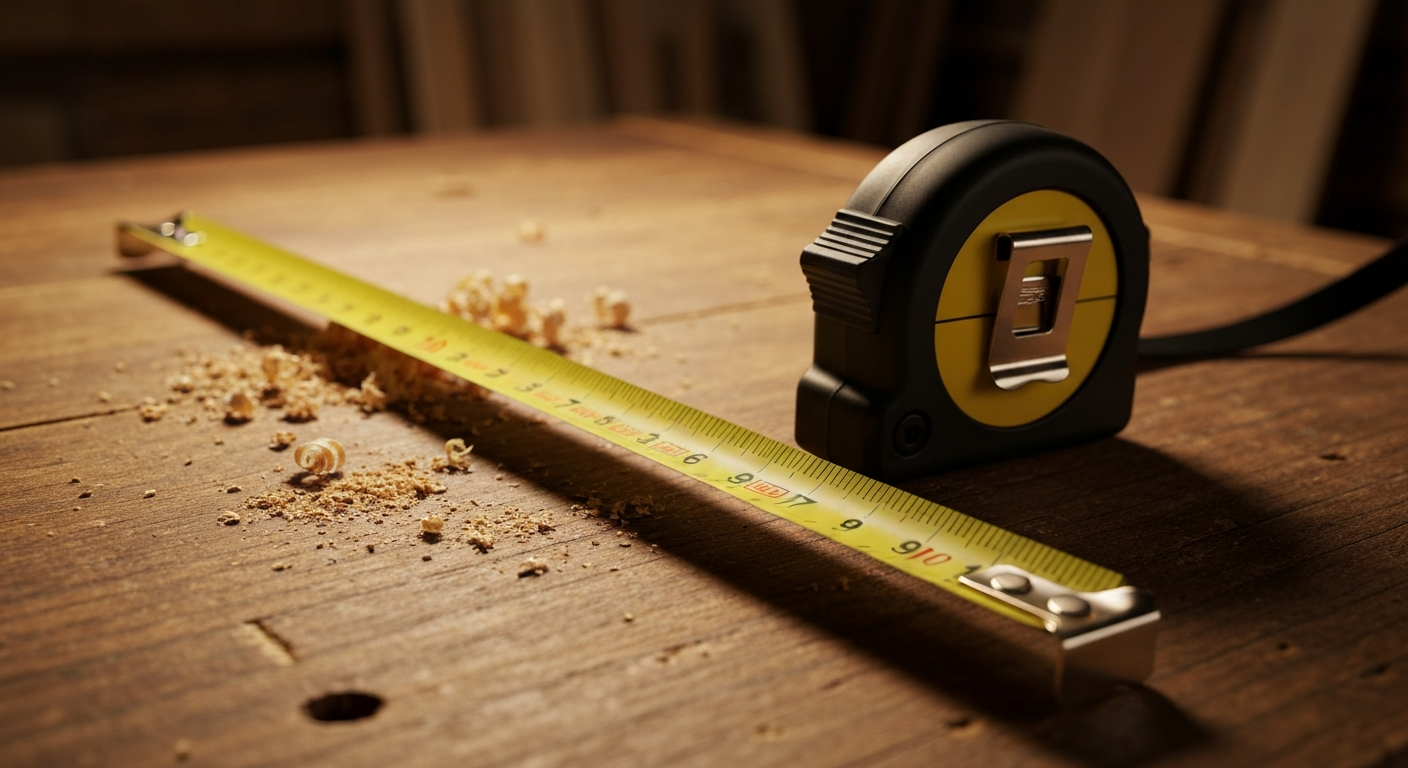
Look for a bent hook, damaged markings, or a blade that does not retract properly. The end hook on many tape measures is designed to move slightly: STANLEY explains that this compensates for the hook’s thickness when taking inside and outside measurements. See the manufacturer’s explanation.
A moving hook alone is therefore not proof that the tape is broken. If readings disagree or the hook appears damaged, compare against a known reference and replace an unreliable tool. For critical fits, follow the product or installer’s measurement procedure.
Match the shopping list to the measurement sheet
Before ordering, check three things: the unit used by the supplier, the coverage or dimensions of each item, and the return conditions. Save the exact product name with your calculation. Two similar-looking packs can cover different areas.
If you need a measuring tool, compare tape-measure listings on Amazon. This is an affiliate search link, not a tested product recommendation. Use the tool finder for a broader starting list or browse home improvement guides.
Affiliate disclosure: As an Amazon Associate, we earn from qualifying purchases. This article was drafted with AI assistance and checked for its example calculations and linked manufacturer guidance; it does not report hands-on testing.