Why Go Cordless for Soldering
A corded soldering station is still the gold standard for bench work. But the moment you need to solder something away from your workbench — a connector inside an enclosure, a repair in a car, a joint in an installed smart home device — the cord becomes a problem.
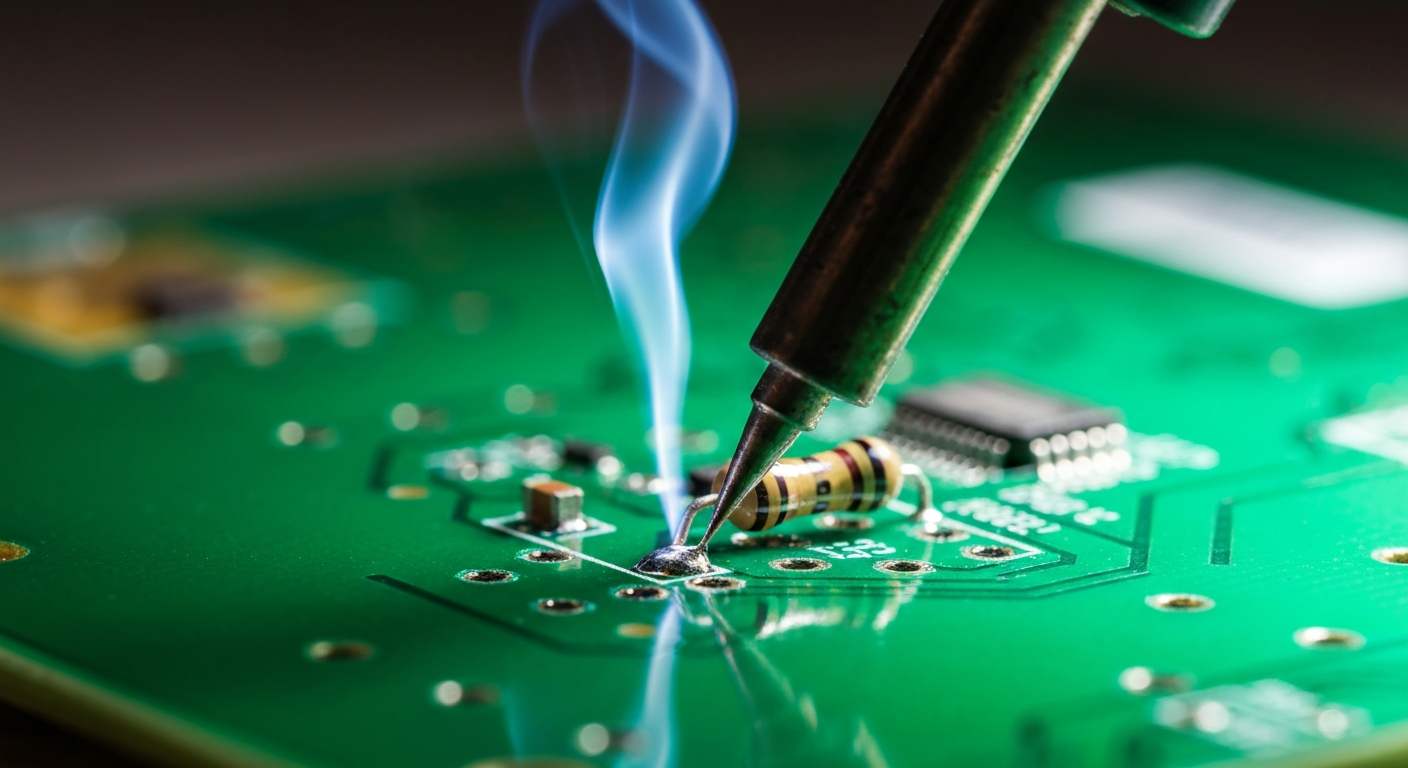
Cordless soldering irons solve this. The current generation heats up in under 10 seconds, maintains temperature well enough for SMD work, and runs long enough to complete real projects on a single charge. They are not replacing your bench station, but they fill a gap that corded irons cannot.
We tested five cordless irons over three months on PCB assembly, connector repairs, wire splicing, automotive wiring, and field installations.
How We Evaluated
- Heat-up time: From cold to working temperature (350C) with a stopwatch
- Temperature stability: Measured with a thermocouple during sustained soldering
- Tip selection: Number and variety of available tips
- Battery life: Continuous soldering until the battery died
- Real-world tasks: Through-hole soldering, SMD rework, wire-to-connector, and field repairs
The 5 Best Cordless Soldering Irons
1. Milwaukee M12 Soldering Iron (2488-20) — Best Overall
Price: $89-109 (tool only) | $149-179 (kit with battery + charger)
The Milwaukee M12 is not a toy pretending to be a soldering iron. It is a legitimate soldering tool that happens to be battery-powered. It reaches 750F (400C) in under 8 seconds, maintains temperature within +/- 5F during sustained soldering, and uses the M12 battery platform that powers 100+ other Milwaukee tools.
What stood out in testing:
- 8-second heat-up. By the time you pick up the solder wire, the iron is ready.
- LED ring around the tip illuminates the work area — genuinely useful inside enclosures and dark spaces
- Temperature-stable enough for SMD rework on 0805 components. We did not expect this from a battery iron.
- A 2.0Ah M12 battery lasted through 45 minutes of intermittent soldering (realistic duty cycle)
- Fuel gauge on the battery. You always know how much runtime remains.
What could be better:
- The tip selection is limited compared to Hakko or Weller bench stations. Milwaukee offers four tips. A bench station offers 20+.
- Tool-only price of $89 assumes you already own M12 batteries. The full kit at $149+ is a significant investment for soldering alone.
- No temperature display. You select from three presets (low/medium/high) rather than dialing an exact temperature.
Best for: Anyone in the Milwaukee M12 ecosystem who needs portable soldering for installations, repairs, and field work. Also excellent as a secondary iron alongside a bench station.
2. Pinecil V2 — Best for Makers on a Budget
Price: $26-32 (iron only, BYO power)
The Pinecil V2 is an open-source soldering iron powered by USB-C PD (65W). It is not technically “cordless” in the traditional sense — it draws power from a USB-C power bank, laptop charger, or any PD source. But plug it into a 65W power bank and you have a truly portable setup that rivals $100+ irons on temperature control.
What stood out in testing:
- PD65W mode reaches 350C in 6 seconds. Faster than the Milwaukee.
- OLED display shows exact temperature, power draw, and tip resistance
- Open-source firmware (IronOS). The community adds features constantly. You can customize everything.
- Compatible with TS100/TS101 tips — hundreds of tip shapes available for $3-8 each
- Weighs 30g. Feels like holding a pen.
What could be better:
- Requires a USB-C PD power source. The iron alone does nothing. Budget $25-40 for a good 65W power bank.
- The barrel is thin. People with larger hands find it uncomfortable during long sessions without a silicone grip.
- No built-in light. You need a headlamp or desk lamp for detail work.
Best for: Arduino tinkerers, maker space regulars, and anyone who already carries a USB-C power bank. Unbeatable value per dollar.
3. TS80P — Best for SMD and Precision Work
Price: $68-85 (iron only, USB-C PD powered)
The TS80P is the Pinecil’s more refined cousin. Same USB-C PD power concept, but with a better industrial design, a motion sensor that auto-sleeps the iron when you set it down, and a slightly larger OLED screen. It uses proprietary TS80 tips that are shorter than TS100 tips, giving you more control over fine work.
What stood out in testing:
- Motion-activated sleep mode. Set it down for 60 seconds and it drops to standby. Pick it up and it recovers in 3 seconds.
- Shorter tip geometry provides excellent control for SMD components and fine pitch connectors
- USB-C PD powers it from any laptop charger. No proprietary batteries.
- Build quality is a step above the Pinecil — metal body, better finish
What could be better:
- Proprietary TS80 tips are more expensive ($12-18) and less available than TS100 tips
- Maximum power is 30W (vs 65W for Pinecil V2 in PD mode). Struggles with large ground planes.
- The higher price over the Pinecil V2 is hard to justify for hobbyists
Best for: SMD rework, fine electronics repair, and makers who value build quality and the auto-sleep feature.
4. Weller WLBRK12 — Best for Field Repairs
Price: $45-65 (kit with butane + tips)
Not every job has electricity nearby. The Weller WLBRK12 runs on butane — the same fuel as a cigarette lighter. No batteries, no USB-C, no outlets. Fill it up and it runs for 2+ hours continuously. This makes it the go-to for electricians, HVAC technicians, and anyone working in remote locations.
What stood out in testing:
- 2+ hours of continuous use on a single butane fill
- Heats up in 30 seconds (slower than electric, but no charging required)
- Includes a hot air tip for heat shrink tubing — useful for wire harness work
- Truly portable. Works in a field, on a roof, in a crawlspace.
What could be better:
- Temperature control is approximate. You adjust a dial, not a digital setting.
- The open flame tip can be a safety concern around flammable materials
- Butane must be refilled. It is cheap but requires carrying a can.
- Less precise than electric irons. Not suitable for SMD or fine electronics work.
Best for: Electricians, automotive technicians, HVAC professionals, and anyone who needs to solder in locations without power.
5. FNIRSI HS-02A — Best Ultra-Budget
Price: $22-28 (iron with built-in battery)
The FNIRSI HS-02A packs a 2500mAh battery inside the iron body itself — no external power bank or battery platform needed. Charge it via USB-C, unplug, and solder. It is genuinely all-in-one portable at a price that makes it almost disposable.
What stood out in testing:
- Built-in battery means zero accessories needed. Charge and go.
- OLED display with actual temperature readout
- Heats to 350C in 8 seconds
- $22 shipped. If you lose it on a job site, you are out a lunch budget, not a tool investment.
What could be better:
- Battery lasts about 15-20 minutes of active soldering. Fine for quick repairs, too short for project work.
- Tip selection is limited to 3-4 shapes
- Build quality reflects the price. The plastic housing feels fragile.
- Temperature accuracy is +/- 15C — acceptable for through-hole, not great for SMD
Best for: A glove-box or toolbox emergency iron. Quick field repairs, wire splices, and situations where you need heat but do not want to carry a full kit.
Which Cordless Soldering Iron Should You Buy?
| Your situation | Get this |
|---|---|
| Already own Milwaukee M12 tools | Milwaukee 2488-20 |
| Maker/Arduino hobbyist on a budget | Pinecil V2 + 65W power bank |
| SMD and precision electronics | TS80P |
| Field work without power | Weller WLBRK12 (butane) |
| Emergency/backup iron | FNIRSI HS-02A |
For most readers of this site who are building Arduino projects or working on smart home installations, the Pinecil V2 offers the best value. If you are already invested in Milwaukee’s platform, the M12 is a no-brainer add-on.
Frequently Asked Questions
Can a cordless soldering iron do SMD work?
The Milwaukee and Pinecil V2 both maintain temperature well enough for 0805 and larger SMD components. For fine-pitch QFP or 0402 components, a bench station with a microscope is still the better tool. The TS80P with its shorter tips comes closest to bench-station precision in a portable form factor.
How long does a cordless soldering iron battery last?
It varies widely. The Milwaukee M12 with a 2.0Ah battery lasts 45+ minutes of intermittent use. USB-C PD irons (Pinecil, TS80P) run as long as your power bank has charge — a 20,000mAh bank provides 3-4 hours easily. The FNIRSI built-in battery lasts about 15-20 minutes.
Is butane or battery better for portable soldering?
Battery (or USB-C PD) is better for electronics work because of temperature precision. Butane is better for field work where charging is not available — plumbing, automotive, HVAC. Choose based on where you will use it.
Do I still need a bench soldering station?
If you solder regularly (weekly or more), yes. A Hakko FX-888D or Weller WE1010 provides better temperature control, more tip options, and a comfortable working position for long sessions. A cordless iron supplements your bench station for portable work — it does not replace it.
What wattage do I need for electronics soldering?
For through-hole components and wire work, 30-40W is sufficient. For SMD rework and large ground planes, 60-65W helps maintain temperature when heat is being drawn away. The Pinecil V2 at 65W PD covers both scenarios.