Why a Miter Saw Belongs in Every Shop
A miter saw does one thing better than any other tool in your shop: precise angled crosscuts. Trim, picture frames, deck boards, furniture parts — any time you need a clean cut at an exact angle, a miter saw is the fastest and most accurate way to get it done. You can make these cuts with a circular saw and a speed square, but the miter saw removes guesswork and does it in two seconds.
The confusing part is the taxonomy. Compound, dual-bevel, sliding, corded, cordless — these words get mixed together on product listings and it’s hard to know what actually matters. Here’s the short version before we get into specific models.
Compound vs Dual-Bevel vs Sliding: What’s the Difference?
Compound miter saw. The blade tilts in one direction (usually left) for bevel cuts, and the turntable rotates for miter cuts. To bevel in the other direction, you flip the workpiece. This is fine for basic trim work and costs the least.
Dual-bevel miter saw. The blade tilts both left and right. You never need to flip the board, which saves time and reduces errors on crown molding and compound angles. Worth the upgrade if you do any trim carpentry.
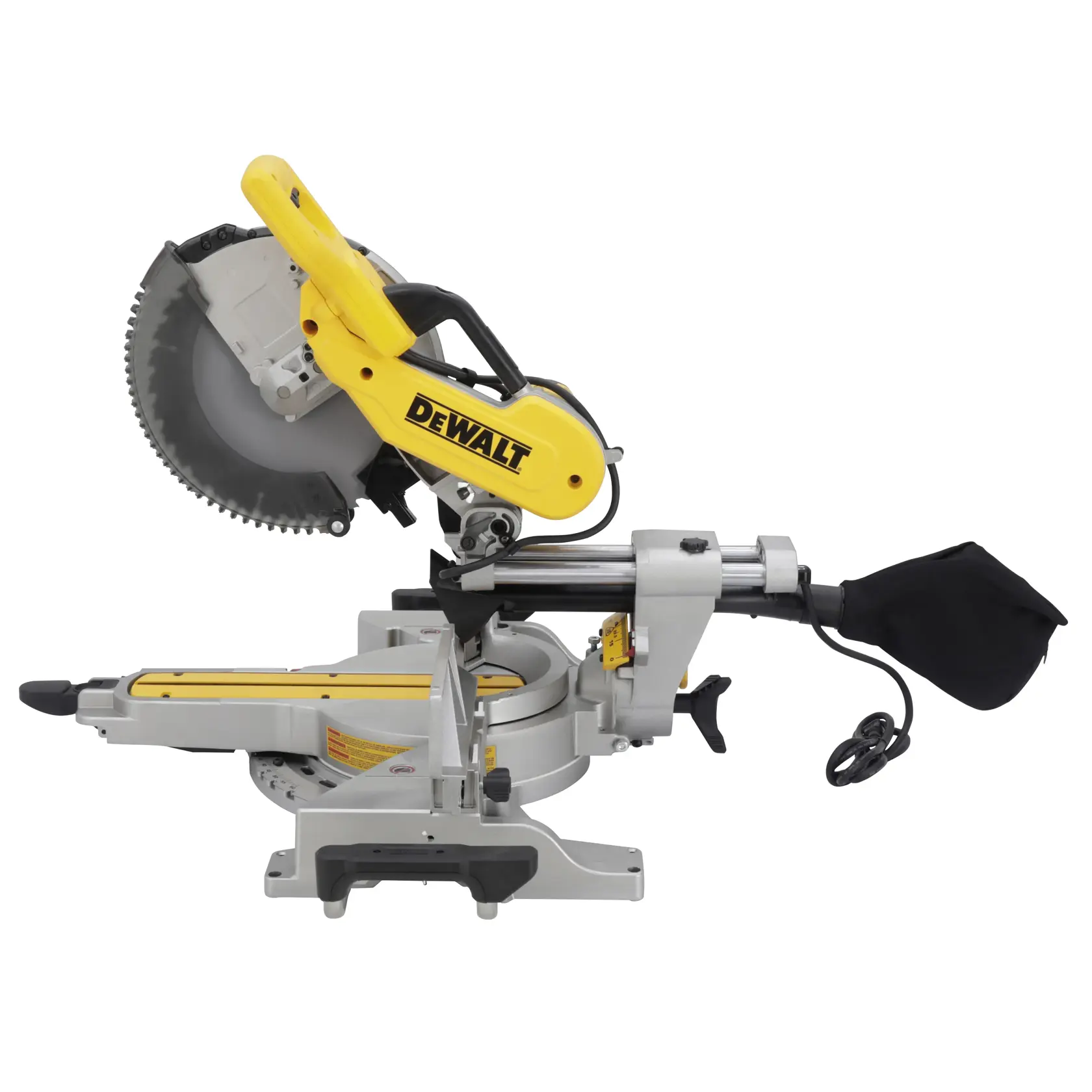
Sliding miter saw. Rails behind the blade let it slide forward and back, dramatically increasing crosscut capacity. A non-sliding 10-inch saw cuts about 6 inches wide. A sliding 10-inch saw cuts 12 inches or more. Essential for cutting wider boards, shelving stock, and sheet trim.
Most saws combine these features. A “12-inch dual-bevel sliding compound miter saw” does all three.
Quick Comparison
| Model | Size | Type | Crosscut Capacity | Bevel | Price |
|---|---|---|---|---|---|
| Metabo HPT C10FCGS | 10” | Compound | 5.5” | Single | ~$120 |
| Ryobi TSS120L | 12” | Sliding | 13.25” | Single | ~$200 |
| DEWALT DCS361B | 7.25” | Sliding (cordless) | 8” | Single | ~$280 |
| DEWALT DWS779 | 12” | Sliding | 13.875” | Dual | ~$400 |
| Makita LS1019L | 10” | Sliding | 12” | Dual | ~$530 |
| Bosch GCM12SD | 12” | Glide | 14” | Dual | ~$600 |
Budget Tier: Under $250
1. Metabo HPT C10FCGS (~$120)
Best Budget Pick · $120 · 10” compound · 15-amp motor · Single bevel
The Metabo HPT C10FCGS is the best miter saw you can buy for under $150. It’s a straightforward 10-inch compound miter saw with a 15-amp motor, 0-52 degree miter range, and a 0-45 degree left bevel. Crosscut capacity tops out at 5.5 inches, which covers 2x4s and standard trim with no issue.
What we love:
- Unbeatable price for a saw that cuts clean and holds its adjustments
- Lightweight at 24.2 lbs — easy to carry to a jobsite or move around a garage
- Positive miter stops at common angles (0, 15, 22.5, 31.6, 45)
Best for: First-time buyers, basic framing, simple trim, and anyone who needs a solid miter saw without spending much.
2. Ryobi TSS120L (~$200)
Best Value Slider · $200 · 12” sliding · 15-amp motor · Single bevel · LED cutline
The Ryobi TSS120L punches way above its price class. It’s a 12-inch sliding miter saw with a 13.25-inch crosscut capacity, an LED cutline indicator, and a 15-amp motor. You get sliding crosscut capacity that rivals saws costing twice as much. The single-bevel limitation means you flip boards for opposite bevel cuts, but for the money, it’s a remarkable amount of saw.
What we love:
- 13.25-inch crosscut capacity handles wide shelving and baseboard stacked flat
- LED cutline is more useful than a laser — it shows the actual kerf shadow
- Soft-start motor reduces startup jerk
Best for: Budget-conscious woodworkers who need wide crosscut capacity for shelving, decking, and trim.
Mid-Range Tier: $250 to $450
3. DEWALT DCS361B (~$280, tool only)
Best Cordless · $280 · 7.25” sliding · 20V MAX · Single bevel · 28 lbs
The DEWALT DCS361B is for the person who needs cuts where there’s no outlet — decks, fences, framing on remote builds. Running on DEWALT’s 20V MAX battery platform, it delivers surprisingly clean cuts through 2x8 dimensional lumber with its 7.25-inch blade and sliding rails. Crosscut capacity is 8 inches. It’s not a shop saw, but as a portable jobsite tool, it’s hard to beat. Battery and charger sold separately.
What we love:
- True portability — no cord, no generator, just grab and go
- 28 lbs makes it the lightest sliding saw in this roundup
- Integrates with the massive DEWALT 20V MAX battery ecosystem
Best for: Jobsite carpenters, deck builders, and anyone already on the DEWALT 20V MAX platform.
4. DEWALT DWS779 (~$400)
Best Overall Value · $400 · 12” dual-bevel sliding · 15-amp · 56 lbs
The DEWALT DWS779 is the miter saw I recommend to most people. It has everything: 12-inch blade, dual-bevel capability, sliding rails for a 13.875-inch crosscut capacity, a 15-amp motor with 3,800 RPM, and a tall sliding fence for crown molding up to 7.5 inches nested. The dust collection bag captures about 75 percent of the dust, which is good for a miter saw. At $400, it delivers features that were $700+ just a few years ago.
What we love:
- Dual-bevel means you never flip crown molding or complex trim pieces
- 13.875-inch crosscut capacity handles almost any board you’ll cut in a home shop
- Built like a tank — the cast aluminum base and steel rails hold up to years of jobsite abuse
Best for: The majority of woodworkers and DIYers. If you buy one miter saw and want it to cover everything, this is it.
Pro Tier: $500+
5. Makita LS1019L (~$530)
Most Compact Slider · $530 · 10” dual-bevel sliding · 15-amp · Direct-drive · Built-in LED
The Makita LS1019L solves the biggest problem with sliding miter saws: they need clearance behind the saw for the rails to slide back. Makita’s direct-drive design eliminates the rear rail overhang entirely. The saw head moves on an internal mechanism, so you can push it flat against a wall. If your shop is tight, this is a game-changer. You still get a 12-inch crosscut capacity, dual-bevel to 48 degrees, and a built-in LED work light.
What we love:
- Zero rear clearance — mount it against a wall on a narrow bench
- Incredibly smooth, precise cuts with almost no blade deflection
- Quieter than most 10-inch saws thanks to the direct-drive motor
Best for: Small shops, wall-mounted miter stations, and anyone who values precision and compact footprint over raw cut capacity.
6. Bosch GCM12SD (~$600)
Best Premium · $600 · 12” dual-bevel glide · 15-amp · Axial-Glide system
The Bosch GCM12SD is the best miter saw in this roundup, full stop. The Axial-Glide system replaces traditional rails with a multi-articulating arm that eliminates rear overhang (like the Makita) while delivering a massive 14-inch crosscut capacity with a 12-inch blade. The upfront bevel controls are easy to reach, detents are precise, and the stainless steel miter plate with cam-lock is the best miter system in any consumer miter saw. It weighs 65 lbs, so it’s a shop saw, not a jobsite hauler.
What we love:
- Axial-Glide system: zero rear clearance with the widest crosscut in its class
- Silky-smooth glide action with virtually no play or deflection
- Upfront bevel controls so you never reach behind the saw
Best for: Serious woodworkers and trim carpenters who want the best cut quality and ergonomics available.
What About a Miter Saw Stand?
A miter saw without a good stand is awkward to use. For shop use, build a dedicated miter station with a sacrificial fence and extension wings — it’s a weekend project that transforms your workflow. For jobsite portability, the DEWALT DWX726 rolling stand ($200) is the standard, and the Bosch T4B gravity-rise stand ($300) is the premium option.
If you’re also looking at table saws, a miter saw is the perfect companion. The table saw handles rip cuts and sheet goods, the miter saw handles crosscuts and angles. Together, they cover about 95 percent of all cuts in a woodshop.
Final Verdict
For most people, the DEWALT DWS779 at $400 is the sweet spot. Dual-bevel, sliding, 12-inch blade, and built to last. If your budget is tight, the Ryobi TSS120L at $200 gives you sliding capability at a shocking price. If you want the best and your shop space is limited, the Bosch GCM12SD at $600 is the saw you’ll never outgrow.
If you’re still deciding between categories of saw, our sliding miter saw buyer’s guide goes deeper on when the slide rail is actually worth the extra money, and table saw vs circular saw covers the other half of the rip-cut equation. For more tool roundups, the woodworking category has the full shop-build series.
Frequently Asked Questions
Is a 10-inch or 12-inch miter saw better?
A 12-inch miter saw offers more crosscut capacity — roughly 8 inches at 90 degrees versus about 6 inches on a 10-inch — and handles thick trim and 4x4 posts without flipping the workpiece. A 10-inch saw is lighter, quieter, uses cheaper blades, and is plenty for most furniture and standard trim. If you mostly cut 2x material and baseboard, a 10-inch is fine. If you regularly cut crown molding nested, 5/4 decking, or 4x4s, pay for the 12-inch.
Do I really need a dual-bevel miter saw?
Only if you cut a lot of bevels. A single-bevel saw makes you flip the workpiece to cut a mirrored angle — fine for occasional use, frustrating when you’re installing a room of crown molding. Dual-bevel pays for itself on trim jobs but is overkill if you mostly crosscut square stock.
Is a sliding miter saw worth the extra cost?
Yes, if you cut boards wider than 6 inches. The slide rail extends the effective cut capacity to 12-14 inches, which covers most shelf boards, stair treads, and deep trim. If you rarely cut anything wider than a 2x6, a fixed compound saw saves money and takes up less bench space.
How long should a miter saw last?
A quality miter saw from DEWALT, Bosch, Makita, or Milwaukee will last 15-20 years of hobby use, or 5-8 years of daily professional use. The motor brushes and the pivot arm pin are the most common wear points; both are serviceable. Cheap big-box brands typically develop blade wobble within a few years.
Can I use a miter saw to rip boards?
No. A miter saw is designed for crosscuts only — ripping on a miter saw is dangerous and will bind the blade. Use a table saw or a track saw for rip cuts. Our table saw vs circular saw comparison covers the safer options.
What blade should I put on my miter saw?
Swap the stock blade for a 60-80 tooth ATB (alternating top bevel) fine-finish blade for trim and hardwood, or a 40-tooth combination blade for general shop use. A Freud Diablo D1080X or Forrest Chopmaster both run around $80-$120 and dramatically improve cut quality over the bargain blade that ships with most saws.
Are cordless miter saws powerful enough?
Modern 60V/80V cordless miter saws from DEWALT FlexVolt, Milwaukee M18 FUEL, and Makita XGT match corded performance for 200-400 cuts per charge. If you primarily work on jobsites without reliable power, they’re worth it. For a stationary shop saw, corded remains cheaper per watt and never needs a battery swap.
How accurate are miter saw angle detents?
Factory detents at 0, 15, 22.5, 31.6, and 45 degrees are accurate to within about 0.5 degrees on mid-range saws. Premium saws like the Bosch GCM12SD hold closer to 0.1 degrees. For picture frames and perfect 45s, check the detent with a quality square and adjust the fence or use a digital angle gauge. Even the best saw benefits from a test cut before a long trim run.