Quick answer: To find the best multimeter for home use, you need one that measures DC/AC voltage, current, resistance, and continuity. This article reviews five models, from budget to pro ($15-$200), explaining each function and helping you choose based on your specific DIY needs and budget. It’s an indispensable diagnostic tool for troubleshooting anything from dead outlets to car batteries, ensuring electricity is flowing as it should.
Why You Need a Multimeter
A multimeter is the single most useful diagnostic tool you can own. Whether you are troubleshooting a dead outlet, testing car batteries, checking continuity in a wire, or debugging an Arduino circuit, a multimeter answers the question: “Is electricity doing what it should be doing here?”
If you own a home, work on electronics, or do any kind of DIY that involves wires, you need one. The good news is that a capable multimeter costs less than a decent meal out.
This review covers five models ranging from $15 to $200, explains what each measurement actually means, and helps you pick the right one for how you will actually use it.
What a Multimeter Measures (and Why You Care)
Before diving into specific models, here is what the major functions do in practical terms.
DC Voltage (VDC)
Measures voltage from batteries, power supplies, USB ports, Arduino pins, solar panels — anything that provides direct current. This is the measurement you will use most often.
Practical example: Is this 9V battery actually dead, or is my device broken? Touch the probes to the battery terminals. A fresh 9V reads around 9.4V. Below 7V, it is effectively dead for most applications.
AC Voltage (VAC)
Measures voltage from wall outlets and household wiring. In the US, a standard outlet should read approximately 120V.
Safety warning: Measuring AC voltage means probing live household wiring. This is potentially lethal. If you are not comfortable with electrical safety procedures, hire a licensed electrician for any work on your home’s wiring. Always verify your multimeter’s CAT rating is appropriate for the circuit you are measuring.
DC Current (ADC)
Measures how much current is flowing through a circuit. Useful for checking how much power a device is drawing, sizing a power supply, or diagnosing parasitic battery drain.
Practical example: Your car battery keeps dying. Measure the current draw with the car off. Anything over 50mA suggests something is staying on when it should not be.
Resistance (Ohms)
Measures resistance of components, wires, and connections. Confirms resistor values, identifies short circuits, and verifies wire gauge.
Continuity
The single most used function for most people. Continuity testing sends a small current through the circuit and beeps if there is a complete path. Is this wire broken? Does this fuse still work? Is this solder joint actually connected?
Pro tip: A fast, loud continuity beep is the most important feature for usability. You are often looking at the thing you are probing, not at the screen. A slow or quiet beep makes the function significantly less useful.
Capacitance
Measures capacitor values. Useful for verifying components before soldering, or testing whether a capacitor in a broken device has failed.
Diode Test
Checks if diodes and LEDs are functional and identifies their polarity (which direction current flows). Also useful for checking transistor junctions.
Temperature (on some models)
Uses a thermocouple probe (usually included) to measure temperature. Handy for checking soldering iron temperatures, HVAC work, or 3D printer bed temperatures.
Understanding Safety Ratings: CAT Categories
Multimeter safety ratings are not marketing fluff. They indicate how much transient voltage (spike) the meter can survive without exploding. This matters most when measuring household or industrial electrical systems.
| Rating | Where It Is Safe | Typical Use |
|---|---|---|
| CAT I | Low-energy electronics | Arduino, bench power supplies |
| CAT II | Wall outlets, plug-in appliances | Most home use |
| CAT III | Distribution wiring, breaker panels | Electrician work |
| CAT IV | Utility entrance, outdoor wiring | Line side of panel |
For home use, CAT III 600V is the recommended minimum if you will ever probe your breaker panel or wall wiring. For electronics-only use, CAT II or even CAT I is fine.
Critical note: Many cheap meters claim safety ratings that are never actually tested. Stick to reputable brands for any work involving household voltage.
The 5 Best Multimeters for Home Use
1. AstroAI AM33D — Best Budget Pick
Price: ~$15 | Category Rating: CAT II 600V
The AstroAI AM33D does the basics well at a price that makes it almost impulse-buy territory. It measures AC/DC voltage, DC current, resistance, continuity (with buzzer), and diode test.
Strengths:
- Incredibly affordable
- Clear backlit LCD display
- Auto-ranging (you do not need to manually select the range)
- Includes battery, test leads, and a protective rubber case
Limitations:
- Continuity response is a bit slow
- No True RMS (AC voltage readings may be inaccurate for non-sinusoidal waveforms)
- Test leads are functional but basic quality
- No capacitance or temperature measurement
Best for: Homeowners who need a meter for occasional battery testing, outlet checking, and basic continuity checks. If you have never owned a multimeter, this is a fine starting point.
Check price on Amazon
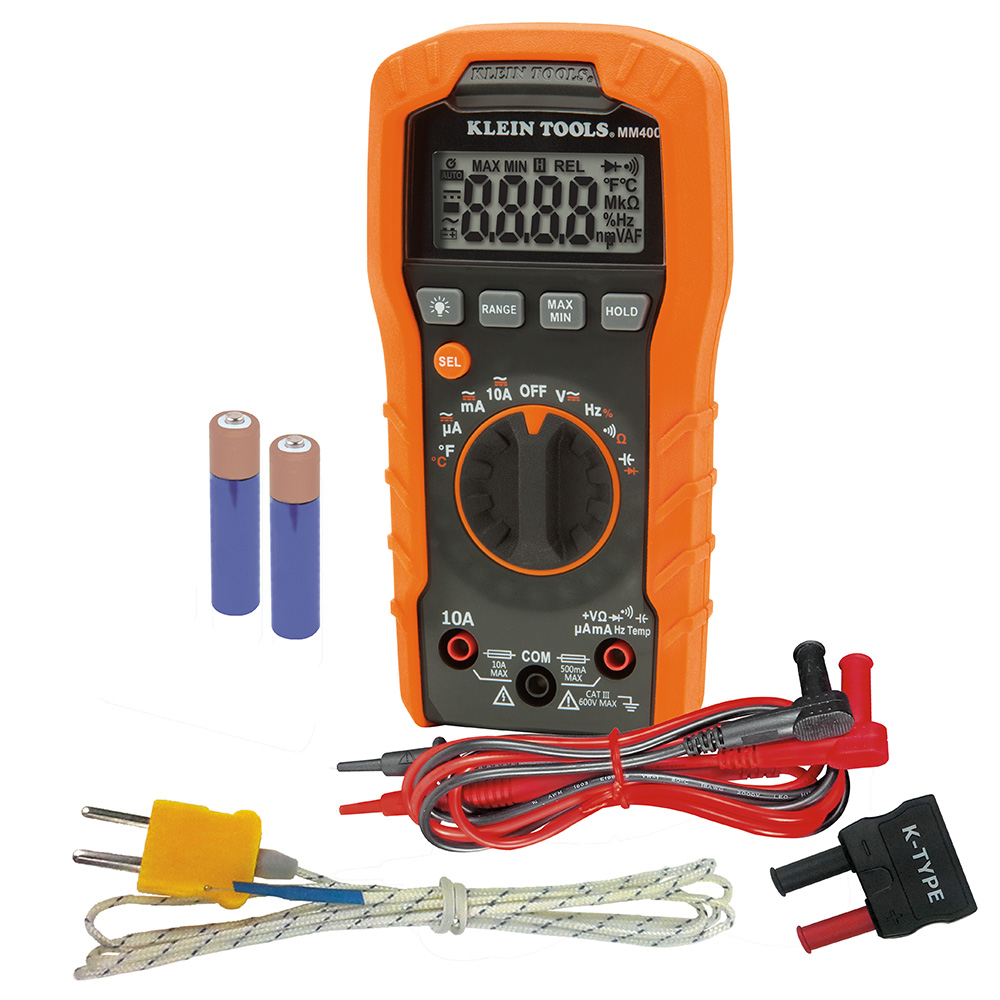
2. Klein Tools MM400 — Best for Home DIY
Price: ~$35 | Category Rating: CAT III 600V
Klein Tools makes professional-grade hand tools, and the MM400 brings that quality to a budget-friendly multimeter. The CAT III rating means it is genuinely safe for probing your breaker panel, which the cheapest meters are not.
Strengths:
- True CAT III 600V safety rating from a reputable manufacturer
- Fast, loud continuity beep (noticeably better than cheaper meters)
- Measures temperature with included thermocouple
- Capacitance measurement
- Auto-ranging with manual override
- Built to survive being dropped (rubber holster included)
Limitations:
- Not True RMS
- No backlight on this specific model (the MM600 has one for ~$55)
- Slightly bulky compared to compact meters
Best for: Anyone who does real home improvement work — installing light fixtures, troubleshooting outlets, checking breaker panels. The safety rating and build quality justify the extra money over a $15 meter.
Check price on Amazon
3. Fluke 101 — Best Compact Meter
Price: ~$50 | Category Rating: CAT III 600V
Fluke is the gold standard name in test equipment. The 101 is their most affordable model, designed as a pocket meter for field use. It does fewer things than some competitors, but does them with Fluke-level accuracy and reliability.
Strengths:
- Fluke build quality and accuracy (0.5% DC voltage accuracy)
- Truly pocketable — fits in a shirt pocket
- Very fast continuity response
- Reliable auto-ranging
- CAT III 600V
Limitations:
- No current measurement (this is the major omission)
- No capacitance or temperature
- No backlight
- Limited to 600V max
Best for: People who want Fluke reliability in the smallest possible package and do not need current measurement. Excellent as a grab-and-go meter that lives in a toolbox or bag.
Check price on Amazon
4. Fluke 117 — Best All-Rounder
Price: ~$160 | Category Rating: CAT III 600V
The Fluke 117 is the meter that professional electricians and serious hobbyists reach for daily. It includes True RMS measurement, which means AC voltage readings are accurate even with the non-sinusoidal waveforms produced by dimmers, VFDs, and modern electronics.
Strengths:
- True RMS AC measurements (accurate on any waveform)
- AutoVolt mode — automatically selects AC or DC voltage
- Non-contact voltage detection built into the meter body
- Large backlit display
- Fast, responsive continuity
- Includes capacitance, frequency, min/max recording
- Fluke’s renowned durability (built to survive years of daily professional use)
Limitations:
- Price — this is a significant investment for occasional home use
- Current measurement requires going through the Fluke 117’s input jacks (10A max)
- No temperature measurement without accessory probe
Best for: People who use a multimeter frequently and want accuracy they never have to question. Also ideal if you are getting into electrical work beyond basic home improvement. You buy a Fluke 117 once and use it for the next twenty years.
Check price on Amazon
5. UNI-T UT61E+ — Best for Electronics Hobbyists
Price: ~$65 | Category Rating: CAT II 600V
The UT61E+ is a hidden gem that is massively popular in the electronics hobbyist community. It offers features normally found in $200+ meters, including True RMS, a fast 22,000-count display, and data logging via USB.
Strengths:
- True RMS AC measurement
- 22,000-count display (higher resolution than most competitors at this price)
- USB data logging to PC
- Very fast auto-ranging
- Measures capacitance, frequency, duty cycle, temperature
- Excellent continuity response speed
Limitations:
- CAT II rating (not ideal for breaker panel work)
- Bulkier than the Fluke 101 or Klein MM400
- Lesser-known brand in the US (though very established internationally)
- Included test leads should be upgraded for serious work
Best for: Electronics hobbyists, Arduino/Raspberry Pi tinkerers, and anyone who wants advanced measurement features without paying Fluke prices. If most of your multimeter use is at the workbench rather than inside walls, this is the best value on the list.
Check price on Amazon
Comparison Table
| Meter | Price | True RMS | CAT Rating | Current | Capacitance | Temp | Backlight |
|---|---|---|---|---|---|---|---|
| AstroAI AM33D | $15 | No | CAT II | Yes (10A) | No | No | Yes |
| Klein MM400 | $35 | No | CAT III | Yes (10A) | Yes | Yes | No |
| Fluke 101 | $50 | No | CAT III | No | No | No | No |
| Fluke 117 | $160 | Yes | CAT III | Yes (10A) | Yes | No | Yes |
| UNI-T UT61E+ | $65 | Yes | CAT II | Yes (20A) | Yes | Yes | Yes |
Our Recommendations
For most homeowners: The Klein Tools MM400 at $35 is the sweet spot. It is safe for real electrical work (CAT III), has a fast continuity beep, measures temperature and capacitance, and is built to last. It does everything the average homeowner needs without paying for features you will rarely use.
For electronics hobbyists: The UNI-T UT61E+ at $65 gives you True RMS, USB logging, and a high-resolution display that makes bench work a pleasure. The CAT II rating is fine since you are mostly working at low voltages.
If you can only own one meter and might ever touch household wiring: The Fluke 117 at $160 is an investment that pays for itself in reliability and accuracy over decades of use.
For the absolute budget pick: The AstroAI AM33D at $15 works. It is not the best at anything, but it is functional, and having a basic multimeter is infinitely better than having none.
Essential Multimeter Tips
Protect Your Meter (and Yourself)
- Never measure resistance on a live circuit. You will get wrong readings and may damage the meter.
- Always start on the highest range if you are not sure what voltage to expect (or use auto-ranging).
- Check your leads. Damaged insulation on test leads is a safety hazard. Replace them if they are cracked or nicked.
- Replace the fuse. If your meter suddenly will not measure current, the internal fuse likely blew. It is a standard fuse you can replace in minutes, not a broken meter.
Get Better Leads
Most multimeters ship with mediocre test leads. Upgrading to silicone-insulated leads with sharp probe tips makes a noticeable difference in usability. Silicone leads are more flexible, especially in cold weather, and do not tangle as easily.
Use the Continuity Function First
When troubleshooting, start with continuity. Before measuring voltage or resistance, check whether the path you expect to be complete actually is. Broken wires, blown fuses, bad solder joints, and corroded connections all reveal themselves immediately with a continuity check.
A multimeter is the closest thing to X-ray vision for electrical systems. Once you own one and learn to use it, you will wonder how you ever diagnosed anything without it.
For more electronics gear coverage, see our best soldering irons for beginners picks and the rest of the electronics category.
Related Reading
- Best 3D Printers for Beginners: 6 Models Under $500
- 10 Arduino Projects for Beginners: Learn by Building
- DIY Smart Home on a Budget: Complete Setup Guide
Frequently Asked Questions
What CAT rating do I actually need?
CAT II 600V handles most household branch-circuit work (outlets, light fixtures, appliances). CAT III 600V is recommended for breaker panel and service-entrance work. CAT IV is for utility-side measurements and rare for DIYers. Buying a CAT III meter for under $40 is risky — the internal fusing and input protection on sub-$40 meters rarely matches their printed ratings. Spend $70+ for anything inside a panel.
Do I need True RMS?
Yes, if you measure AC voltage on anything other than pure sine waves. Variable-speed motors, LED dimmers, power supplies, and inverters all produce distorted waveforms that non-RMS meters read incorrectly — sometimes by 20 percent or more. For purely resistive household AC (lamps, heating elements), either type works.
Is a $30 multimeter safe for household wiring?
A $30 meter is adequate for low-voltage electronics work and troubleshooting 12V automotive circuits. For 120V/240V household work, invest at least $70-100 in a meter with proper CAT III input protection and quality leads. Cheap meters can explode in your hand during a short-circuit event — it’s rare but documented.
Fluke vs Klein vs cheap Amazon brands — is the premium worth it?
For occasional hobby use, a $50 Klein or UNI-T is genuinely fine. For daily professional use or anything involving panel work, Fluke’s input protection, accuracy, and long-term calibration stability earn the premium. A Fluke 117 bought today will likely still read true in 20 years; cheap meters drift within 2-3 years.
How often should I calibrate my multimeter?
Home users almost never need to. Professionals working in regulated industries calibrate annually against a known reference. For DIY use, check your meter once a year against a known 9V battery or a reliable outlet reading. Dramatic drift means replace or send for service.
Can a multimeter measure amps on a live circuit?
Yes, but only in series with the load, not in parallel. Placing a meter’s amp leads across a voltage source shorts the circuit through the meter’s internal fuse — you’ll blow the fuse and possibly the meter. For current measurement on live household circuits, use a clamp meter instead, which measures current without breaking the circuit.
What’s the difference between auto-range and manual-range?
Auto-ranging meters pick the correct measurement range automatically — faster and more beginner-friendly, but slightly slower to settle. Manual-range meters require you to select the expected range, which gives you more control and sometimes better resolution on known values. Most modern meters offer both.
Are pocket multimeters accurate enough?
Yes, for basic pass/fail and ballpark measurements. Pocket meters like the Fluke 101 sacrifice the 10A current input and some advanced functions, but their voltage and resistance accuracy is identical to their full-size counterparts. Great for a glove-box or tool-belt backup meter.