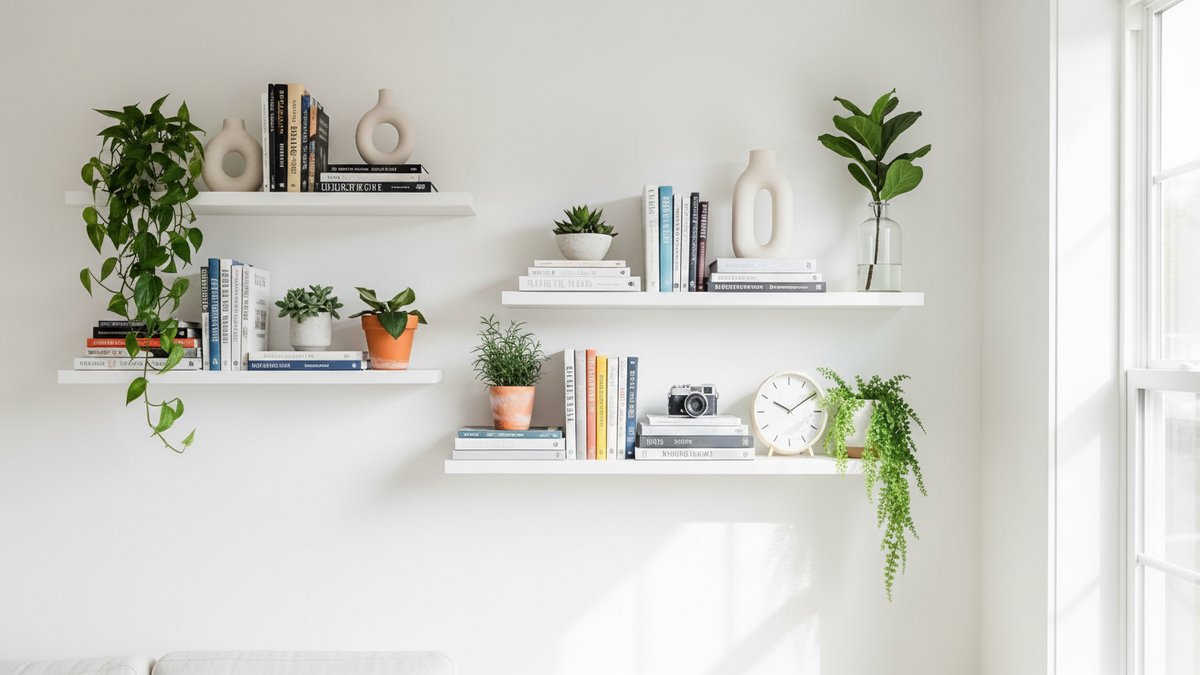
How Floating Shelves Actually Work
A floating shelf looks like it’s bolted to the wall by magic. There’s no visible bracket, no L-shaped support underneath — just a clean slab of wood or MDF extending from the wall. The trick is a hidden bracket system. A metal bracket or French cleat mounts to the wall first, then the hollow shelf slides over it. The bracket carries the load, and the shelf hides it completely.
This is why floating shelf weight limits vary so much. A shelf mounted into two studs with a steel rod bracket can hold 30 to 50 lbs. A shelf mounted into drywall alone with toggle bolts maxes out around 15 lbs. Understanding this distinction before you buy saves you a collapsed shelf and a pile of broken ceramics.
Tools and Materials You’ll Need
- Stud finder (electronic or magnetic)
- Level (24-inch or longer)
- Drill/driver
- Drill bits (1/8” pilot, plus bit size matching your wall anchors)
- Pencil
- Tape measure
- Floating shelf with mounting hardware (bracket or cleat included)
- Drywall anchors or toggle bolts (if no studs available)
If you need a reliable stud finder, check our best stud finders roundup.
Step-by-Step Installation
Step 1: Find Your Studs
Use a stud finder to locate studs in your mounting area. Mark both edges of each stud with a pencil, then mark the center. Standard stud spacing is 16 inches on center, so if you find one stud, the next is likely 16 inches away. For the strongest mount, plan to hit at least two studs.
Step 2: Mark Your Level Line
Hold the bracket (or the back of the shelf) against the wall at your desired height. Place a level on top and adjust until the bubble is centered. Draw a light pencil line along the top or bottom edge. This line is your reference for the entire installation.
Step 3: Mark and Drill Pilot Holes
Align the bracket with your level line and the stud center marks. Use a pencil to mark through the bracket’s screw holes onto the wall. Drill pilot holes at each mark using a 1/8-inch bit. For drywall-only mounting, drill larger holes sized for your toggle bolts or anchors.
Step 4: Mount the Bracket
Secure the bracket to the wall using the included lag screws (for studs) or toggle bolts (for drywall). Tighten firmly but don’t overtorque — you can crack the drywall face or strip the stud. Check level one more time.
Step 5: Slide the Shelf On
Most floating shelves slide onto the bracket from the front or drop down from above. Align the shelf cavity with the bracket rods or rail, then push it flush to the wall. Some shelves include a small set screw underneath to lock the shelf to the bracket. Tighten it if present.
Step 6: Check and Adjust
Place your level on the shelf surface. If it’s slightly off, loosen the bracket screws, adjust, and retighten. Fill any visible gaps between the shelf and wall with a thin bead of paintable caulk for a seamless look.
Drywall-Only Mounting (No Studs)
Sometimes your shelf position doesn’t line up with studs. In that case, use toggle bolts — not plastic drywall anchors. A standard 1/4-inch toggle bolt holds 50 lbs in 1/2-inch drywall. Two toggle bolts give you enough capacity for a lightly loaded floating shelf (books, small plants, picture frames). Keep total shelf load under 15 lbs for drywall-only mounts to be safe.
Weight Limit Quick Reference
| Mounting Method | Max Weight Per Shelf |
|---|---|
| Two studs + steel bracket | 30-50 lbs |
| One stud + one toggle bolt | 20-30 lbs |
| Two toggle bolts (drywall only) | 10-15 lbs |
| Plastic drywall anchors | Not recommended |
5 Best Floating Shelves in 2026
1. Prepac Floating Entryway Shelf (~$35)
Best Basic Pick · $35 · 48” wide · MDF with laminate · Hidden bracket · 50 lb capacity
The Prepac is a no-nonsense MDF shelf with a clean laminate finish available in black, white, and espresso. The hidden mounting rail system is sturdy and installs in under 20 minutes. At 48 inches wide, it’s ideal for entryways and above-desk setups. Weight capacity is listed at 50 lbs when mounted into studs.
Best for: Entryways, desks, and anyone who wants a clean, affordable floating shelf.
2. BAMFOX Floating Shelves (Set of 2, ~$28)
Best Natural Material · $28/pair · 16” wide · Solid bamboo · Metal L-bracket hidden · Lightweight
The BAMFOX shelves are solid bamboo with a natural grain finish. They ship as a pair of 16-inch shelves with concealed metal brackets. Bamboo is harder than most softwoods and naturally moisture-resistant, so these work well in kitchens and bathrooms. Weight capacity is around 20 lbs per shelf when stud-mounted.
Best for: Kitchens, bathrooms, and anyone who wants a warm, natural material at a low price.
3. ClosetMaid White Wire Shelving (~$15 per 3-ft shelf)
Most Practical · $15 · 12” deep · Ventilated wire · Standard bracket mount · 50 lbs
ClosetMaid wire shelving isn’t glamorous, but it’s incredibly functional. The ventilated design is perfect for closets, laundry rooms, and pantries where airflow matters. Mounting uses standard wall-clip brackets that screw into studs. Easy to cut to custom lengths with bolt cutters.
Best for: Closets, pantries, laundry rooms — anywhere function matters more than aesthetics.
4. Umbra Conceal Bookshelf (~$15)
Coolest Design · $15 · Holds 4-6 books · Steel L-bracket · Invisible when loaded
The Umbra Conceal is a small steel bracket that hides completely behind a stack of books. The bottom book’s cover rests on the lower lip, and the shelf becomes invisible. It’s not really a floating shelf — it’s a floating book stack. Holds about 15 lbs. Endlessly fun as a conversation piece.
Best for: Book lovers, small spaces, and anyone who wants an invisible shelf.
5. DIY French Cleat Shelf (~$10-20 in materials)
Best DIY Option · $10-20 · Any length · Solid wood · French cleat system · Strongest option
If you want full control over size, material, and finish, build your own. A French cleat shelf uses two interlocking 45-degree beveled strips — one on the wall, one on the shelf back. It’s the strongest floating mount system and allows you to remove and reposition the shelf without new holes. We have a full floating shelf build guide with cut lists and dimensions.
Best for: Woodworkers who want a custom size, material, and finish.
Styling Tips
- Odd numbers. Group items in threes or fives for visual balance.
- Vary height. Mix tall items (vases, books standing up) with short items (candles, small pots).
- Leave breathing room. A shelf crammed edge-to-edge looks cluttered. Leave 20-30 percent of the surface empty.
- Layer depth. Place taller items in the back, shorter in front, to create a sense of depth.
Final Thoughts
Floating shelves are one of the simplest, highest-impact upgrades you can make to any room. The installation takes 30 minutes if you hit studs, and the result looks like custom built-in woodwork. Just remember: find your studs first, use a level, and don’t exceed the weight rating for your mounting method.
For a deeper project, check our guide on building bookshelves from scratch. When you are ready to go beyond individual shelves, the 10 DIY Shelving Ideas: Floating, Built-In, and Wall Shelves guide covers pipe shelves, ledge shelves, and full floor-to-ceiling built-ins.