A multimeter is an indispensable tool for anyone venturing into DIY electronics, home repair, or automotive diagnostics. It’s your window into the invisible world of electricity, allowing you to measure voltage, current, resistance, and often much more. While high-end professional models can cost hundreds, you don’t need to break the bank to get a reliable, feature-rich multimeter that meets most DIY needs. For under $100, you can find excellent options that offer accuracy, safety, and durability.
In this guide, we’ll walk you through what to look for, decipher common specifications, and then dive into our top six picks for the best multimeters under $100, perfect for the build-coded.com community.
How to Pick a Multimeter
Choosing the right multimeter involves understanding a few key specifications that directly impact its safety, accuracy, and suitability for your projects.
CAT III vs CAT IV: Understanding Overvoltage Protection
The “CAT” rating (Category Rating) indicates a multimeter’s ability to withstand transient overvoltage spikes, which are sudden, brief increases in voltage that can occur in electrical systems. These spikes can be far greater than the nominal circuit voltage and are dangerous.
- CAT II: For measurements on circuits directly connected to the low-voltage installation, like appliance outlets, household appliances, and portable tools. Generally safe for typical wall outlets (up to 600V).
- CAT III: For measurements on fixed installation circuits, such as distribution boards, circuit breakers, wiring, and industrial equipment. This is crucial for working directly on home electrical panels or major appliances. A CAT III 600V meter can safely measure up to 600V in a CAT III environment.
- CAT IV: For measurements at the source of the low-voltage installation, like utility service connections, outside power lines, and electricity meters. These environments have the highest potential for dangerous transient overvoltages.
For most DIYers, a CAT III 600V rating is a good baseline, offering robust protection for residential electrical work and many electronics applications. CAT II is acceptable for basic electronics and appliance testing, but less so for main panel work.
True RMS Explained: Measuring Distorted Waveforms Accurately
When we talk about AC voltage or current, we typically refer to its Root Mean Square (RMS) value. For a perfect sine wave (like what comes out of your wall outlet), a standard “average responding” multimeter can accurately calculate the RMS value. However, many modern electronic devices, motors, and lighting systems use non-linear loads that create distorted, non-sinusoidal waveforms.
A True RMS multimeter measures the actual heating effect of an AC waveform, regardless of its shape. This provides a much more accurate reading for non-sinusoidal AC signals. If you’re working with:
- Variable frequency drives (VFDs)
- Computers and power supplies
- LED lighting
- Motor controls
- Solar power inverters
…then a True RMS multimeter is highly recommended. For simple household wiring or purely resistive loads, it might not be strictly necessary, but it’s a significant upgrade in accuracy for a small price difference in many modern meters.
Accuracy Specs Decoded: How Precise Is Your Reading?
Multimeter accuracy is usually expressed as a percentage, often followed by a number of “digits” or “counts.” For example, ”±(0.5% + 2 digits)” for DC voltage.
- Percentage (%): This refers to the percentage of the reading. If you’re measuring 100V with 0.5% accuracy, the error could be ±0.5V.
- Digits/Counts: This refers to the least significant digit on the display. If the reading is 100.0V and the “2 digits” error applies, the error could be ±0.02V (since it’s the last two digits of the display).
So, for a 100V reading with an accuracy of ±(0.5% + 2 digits), the total error would be ±(0.5% of 100V + 0.02V) = ±(0.5V + 0.02V) = ±0.52V. This means your true voltage is likely between 99.48V and 100.52V.
For DIY and home repair, an accuracy of 0.5% to 1.0% for DC voltage is generally sufficient. More critical electronics work might benefit from lower percentages.
What Input Impedance Means for Low-Voltage Circuits
Input impedance refers to the resistance a multimeter presents to the circuit it’s measuring.
- High Input Impedance (typically 1 MΩ or 10 MΩ): This is crucial for sensitive electronics and low-voltage circuits. A high impedance meter draws very little current from the circuit, thus minimally affecting the circuit’s operation and providing an accurate voltage reading. Most modern digital multimeters (DMMs) have high input impedance for voltage measurements.
- Low Input Impedance (LoZ): Some advanced multimeters offer a LoZ mode. This intentionally lowers the input impedance to drain “ghost voltages” – induced voltages that can appear on unused or open wires due to electromagnetic fields from adjacent live wires. While useful for electricians to distinguish real voltage from ghost voltage, it’s not typically a primary concern for basic DIY electronics work and is rare in meters under $100.
For general electronics and most DIY tasks, ensure your multimeter has a high input impedance (usually 1MΩ or 10MΩ, which is standard for DMMs) when measuring voltage to avoid loading down the circuit.
Safety Rating Decoded
Understanding the CAT ratings is paramount for your safety, especially when working with household electricity. These ratings are established by international standards (IEC 61010) and define where a multimeter can be safely used.
-
CAT II (Category II):
- Description: For measurements performed on circuits directly connected to the low-voltage installation. This covers appliance outlets, household appliances, and portable tools. The danger here comes from the appliance itself, not the main service.
- Examples: Testing a wall outlet, checking the voltage on a power cord, troubleshooting a washing machine’s control board, working on the internal electronics of a computer.
- Max Voltage: Typically rated for 600V or 1000V. A CAT II 600V meter is safe for 120V/240V circuits at the point of use.
-
CAT III (Category III):
- Description: For measurements performed on fixed installation circuits. This includes distribution boards, circuit breakers, switches, wiring, and industrial equipment. These locations can experience more significant transient overvoltages.
- Examples: Measuring voltage at your home’s main electrical panel, checking a circuit breaker, wiring a new light fixture or ceiling fan, troubleshooting an outdoor AC unit.
- Max Voltage: Typically rated for 600V or 1000V. A CAT III 600V meter provides robust protection for residential electrical work.
-
CAT IV (Category IV):
- Description: For measurements performed at the source of the low-voltage installation. This covers utility service connections, outside power lines, and electricity meters. These are the highest energy environments in a low-voltage system and can have very dangerous transient overvoltages.
- Examples: Working on the service drop from the utility pole, measuring at the electricity meter, troubleshooting underground electrical feeds.
- Max Voltage: Typically rated for 600V or 1000V. Most DIYers should never need a CAT IV meter and should avoid working in these high-risk areas. If you’re working on a home’s main panel, a CAT III meter is generally sufficient and recommended.
Important Note: A multimeter’s voltage rating (e.g., 600V) only tells you the maximum continuous voltage it can measure. The CAT rating tells you the maximum transient overvoltage it can safely withstand in a given environment. Always use a meter with an appropriate CAT rating for the environment you’re working in. Never use a CAT II meter to work on a main service panel, for instance.
The 6 Picks Ranked: Best Multimeters Under $100
We’ve carefully selected these multimeters, balancing features, accuracy, safety, and price to give you the best options for under $100 in 2026.
1. Brymen BM235 ($95)
The Brymen BM235 is often hailed as a “Fluke killer” for its incredible value, offering professional-grade features and safety at a fraction of the cost. If you can stretch your budget close to $100, this is arguably the best all-around choice.
- Measurement Ranges:
- VDC: 0.1mV to 1000V
- VAC: 0.1mV to 1000V
- ADC/AAC: 0.1µA to 10A
- Resistance: 0.1Ω to 60MΩ
- Capacitance: 0.1nF to 60mF
- Frequency: 0.001Hz to 100kHz
- Diode, Continuity, Temperature (Type K thermocouple)
- CAT Rating: CAT IV 300V / CAT III 600V
- Accuracy %: VDC ±(0.3% + 2 digits)
- True RMS: Yes
- Auto-ranging: Yes
- Best for: Electronics bench, home electrical, automotive diagnostics, advanced hobbyists.
What We Like:
- Exceptional Build Quality: Robust casing, excellent input protection, and a clear, backlit display.
- High Accuracy & True RMS: Provides highly reliable readings for all waveforms, crucial for modern electronics.
- Comprehensive Features: Covers almost every measurement a DIYer or prosumer could need, including a wide capacitance range and temperature.
- Superior Safety: CAT IV 300V / CAT III 600V rating offers top-tier protection for various applications, including some higher-energy environments.
- Fast Continuity: Very quick and responsive continuity buzzer.
What We Don’t:
- Price Point: While under $100, it’s at the very top of the budget, leaving little room for accessories.
- Brand Recognition: Less recognized than Fluke or Klein, though highly respected in enthusiast communities.
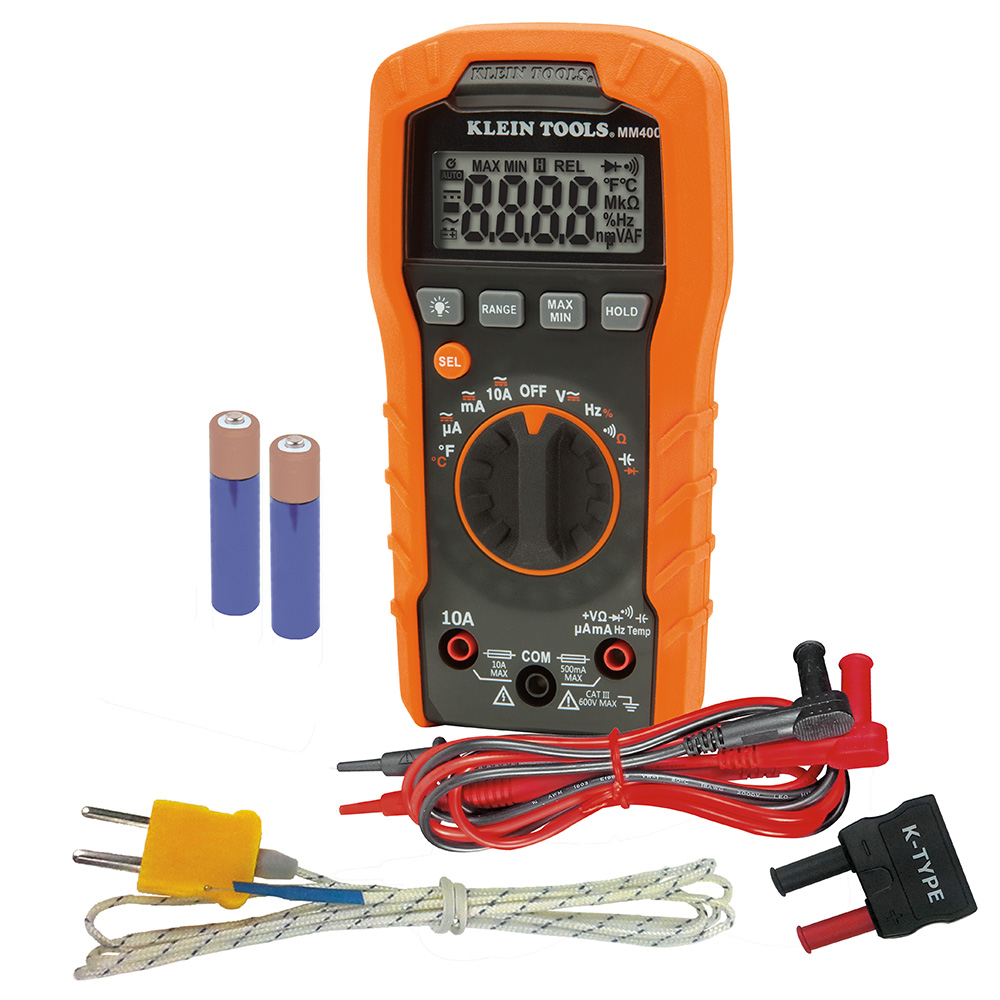
2. Klein Tools MM400 ($70)
Klein Tools is a trusted name among electricians, and their MM400 multimeter lives up to that reputation. It’s a robust, feature-rich meter that’s perfect for home electrical work and general DIY, offering excellent value for its price.
- Measurement Ranges:
- VDC: 0.1mV to 600V
- VAC: 0.1mV to 600V
- ADC/AAC: 0.1µA to 10A
- Resistance: 0.1Ω to 40MΩ
- Capacitance: 1nF to 1000µF
- Frequency: 1Hz to 50kHz
- Diode, Continuity, Temperature (Type K thermocouple)
- CAT Rating: CAT III 600V
- Accuracy %: VDC ±(0.5% + 2 digits)
- True RMS: Yes
- Auto-ranging: Yes
- Best for: Home electrical, automotive repair, general DIY, light electronics.
What We Like:
- True RMS at a Great Price: Offers accurate readings for non-sinusoidal AC signals without breaking the bank.
- Rugged Design: Built to withstand job site conditions, with a durable casing and integrated lead holders.
- Comprehensive Features: Includes AC/DC current, temperature, capacitance, and frequency, making it versatile for many tasks.
- Clear, Backlit Display: Easy to read in various lighting conditions.
- Trusted Brand: Klein’s reputation for quality tools provides peace of mind.
What We Don’t:
- Slightly Slower Continuity: Not as lightning-fast as some higher-end meters, but still perfectly functional.
- Capacitance Range: While good, it’s not as extensive as the Brymen for very large capacitors.
3. AstroAI DM6000AR ($40)
The AstroAI DM6000AR punches well above its weight class, offering True RMS and a high count display at an incredibly affordable price. It’s an excellent choice for budget-conscious DIYers who still want advanced features.
- Measurement Ranges:
- VDC: 0.1mV to 1000V
- VAC: 0.1mV to 750V
- ADC/AAC: 0.1µA to 10A
- Resistance: 0.1Ω to 60MΩ
- Capacitance: 1nF to 100mF
- Frequency: 1Hz to 10MHz
- Diode, Continuity, Temperature (Type K thermocouple), NCV (Non-Contact Voltage)
- CAT Rating: CAT III 600V / CAT II 1000V
- Accuracy %: VDC ±(0.5% + 3 digits)
- True RMS: Yes
- Auto-ranging: Yes
- Best for: Electronics bench, hobby, home electrical (general), automotive repair.
What We Like:
- Unbeatable Value: True RMS, 6000 counts, NCV, and a wide range of measurements for under $40.
- High Measurement Ranges: Can handle up to 1000V DC and has a very wide capacitance range.
- Non-Contact Voltage (NCV): A convenient safety feature for quickly detecting live wires without direct contact.
- Backlit Display & Kickstand: Enhances usability in various settings.
- Good for Beginners: Offers auto-ranging and a comprehensive feature set without being overly complex.
What We Don’t:
- Build Quality: While decent for the price, it won’t feel as robust or durable as a Klein or Brymen.
- Probe Quality: Included probes are functional but often benefit from an upgrade for better comfort and durability.
- Accuracy at Extremes: While generally good, its accuracy might not be as consistently precise as higher-end models, especially at the very edges of its ranges.
4. Fluke 101 ($60-80)
The Fluke 101 is the entry-level offering from the industry-standard brand, Fluke. While it might seem basic compared to others on this list, its reputation for reliability, accuracy, and robust safety is unmatched. It’s a “no-frills, gets-the-job-done” kind of meter.
- Measurement Ranges:
- VDC: 0.1mV to 600V
- VAC: 0.1mV to 600V
- ADC: 0.1µA to 10A (no AC current)
- Resistance: 0.1Ω to 40MΩ
- Diode, Continuity
- CAT Rating: CAT III 600V
- Accuracy %: VDC ±(0.5% + 3 digits)
- True RMS: No
- Auto-ranging: Yes
- Best for: Home electrical, general DIY, basic electronics, reliability-focused users.
What We Like:
- Fluke Reliability: You’re buying into the legendary quality and durability of Fluke. It’s built to last and perform consistently.
- Exceptional Safety: Robust CAT III 600V protection, often exceeding competitors in its internal safety features.
- Compact and Ergonomic: Easy to hold and use with one hand, making it convenient for various tasks.
- Simple Operation: Straightforward, auto-ranging functions make it user-friendly for beginners.
- Excellent Battery Life: Known for long-lasting performance on a single set of batteries.
What We Don’t:
- No True RMS: This is its biggest drawback, limiting its accuracy on non-sinusoidal AC waveforms.
- Limited Features: No AC current, capacitance, frequency, or temperature measurements. It’s a bare-bones meter.
- Price for Features: For the same price, you can get meters with many more features (e.g., Klein MM400). You’re paying for the Fluke name and its inherent reliability.
- No Backlight: Can be hard to read in dim conditions.
5. Innova 3340 ($45)
The Innova 3340 is specifically designed with the automotive DIYer in mind. If your primary use case is working on cars, trucks, or motorcycles, this meter offers specialized functions that make vehicle diagnostics much easier.
- Measurement Ranges:
- VDC: 0.1mV to 600V
- VAC: 0.1mV to 600V
- ADC: 0.1µA to 10A (no AC current)
- Resistance: 0.1Ω to 20MΩ
- Diode, Continuity
- Specialized: RPM (inductive clamp), Dwell, Duty Cycle, Temperature (Type K thermocouple), Battery Test (1.5V/9V), Alternator Test.
- CAT Rating: CAT II 600V
- Accuracy %: VDC ±(0.8% + 2 digits)
- True RMS: No
- Auto-ranging: Yes
- Best for: Automotive repair, vehicle diagnostics.
What We Like:
- Automotive Specific Features: RPM, Dwell, and battery/alternator tests are invaluable for vehicle troubleshooting. The inductive RPM clamp is particularly useful.
- Integrated Kickstand and Rubber Corner Guards: Designed for garage environments.
- Ease of Use: Clear, large display and intuitive function selection for automotive tasks.
- Affordable: A very reasonable price for a specialized automotive meter.
- Temperature Measurement: Useful for engine diagnostics.
What We Don’t:
- No True RMS: Limits its utility for complex modern automotive electronics that might use non-sinusoidal signals.
- No AC Current or Capacitance: Less versatile for general electronics or home electrical work.
- CAT II Rating: Adequate for vehicle systems but less protective for home electrical panels.
- Basic Probes: May benefit from an upgrade for better grip and durability.
6. AstroAI WH5000A ($30)
For the absolute beginner or someone who just needs a very basic, no-frills meter for simple hobby electronics or continuity checks, the AstroAI WH5000A is an incredibly inexpensive entry point. It’s a manual-ranging meter, which means you’ll need to select the correct range for your measurement.
- Measurement Ranges:
- VDC: 0.1mV to 600V
- VAC: 0.1V to 600V
- ADC: 0.1µA to 10A (no AC current)
- Resistance: 0.1Ω to 2MΩ
- Diode, Continuity
- CAT Rating: CAT II 600V
- Accuracy %: VDC ±(0.8% + 2 digits)
- True RMS: No
- Auto-ranging: No (Manual Ranging)
- Best for: Hobby electronics, basic continuity checks, learning fundamentals, emergency backup.
What We Like:
- Extremely Affordable: One of the cheapest functional multimeters you can buy.
- Good for Learning: Manual ranging forces users to understand electrical scales, which can be beneficial for beginners.
- Compact Size: Easy to toss in a toolbox or drawer.
- Includes Basic Functions: Measures voltage, current, resistance, and continuity – the core functions.
What We Don’t:
- Manual Ranging: Can be frustrating and slow for those accustomed to auto-ranging. Also, selecting the wrong range can lead to inaccurate readings or blown fuses.
- No True RMS: Not suitable for accurate AC measurements on non-sinusoidal waveforms.
- Limited Ranges: Resistance range is quite limited at 2MΩ, and no capacitance, frequency, or temperature.
- CAT II Rating: Limits its use for more involved home electrical work.
- Basic Build Quality: Expect it to feel less robust than higher-priced options.
Best Multimeter for Each Use Case Table
| Use Case | Best Pick(s) | Key Features |
|---|---|---|
| Overall Best Value | Brymen BM235 | Pro-grade features, True RMS, high accuracy, CAT IV/III, wide ranges. |
| Home Electrical | Klein Tools MM400, Fluke 101, Brymen BM235 | CAT III 600V, True RMS (MM400/BM235), robust build, reliable readings. |
| Electronics Bench | Brymen BM235, AstroAI DM6000AR | True RMS, high accuracy, wide capacitance/frequency, high input impedance. |
| Automotive Repair | Innova 3340, Klein Tools MM400, AstroAI DM6000AR | Specialized automotive functions (Innova), True RMS (Klein/AstroAI), DC current, temperature. |
| Hobbyist/Beginner | AstroAI DM6000AR, AstroAI WH5000A | DM6000AR: Feature-rich for price. WH5000A: Ultra-budget, manual range for learning fundamentals. |
| Reliability Focused | Fluke 101 | Industry-leading durability, safety, and consistent performance, even if features are basic. |
Common Multimeter Mistakes
Even with the best multimeter, user error can lead to inaccurate readings, damaged equipment, or even injury. Here are some common mistakes to avoid:
-
Probes in the Wrong Jacks:
- Mistake: Accidentally placing the red probe in the “mA” or “A” (current) jack when attempting to measure voltage or resistance.
- Why it’s Bad: When measuring voltage or resistance, the multimeter expects a very high impedance. The current jacks, however, have a very low impedance (essentially a short circuit) to measure current in series. If you connect a low-impedance current input directly across a voltage source (like a wall outlet), you create a short circuit. This will blow the multimeter’s internal fuse, potentially damage the meter, or even trip your house’s circuit breaker.
- How to Avoid: Always double-check your probe placement before taking a measurement. The black probe almost always goes into the “COM” (common) jack. The red probe goes into the “VΩHz” jack for voltage, resistance, and continuity, and into the “mA” or “A” jack only when explicitly measuring current.
-
Blown Fuses:
- Mistake: Trying to measure current beyond the multimeter’s rated capacity, or accidentally shorting a voltage source while in current mode (as described above).
- Why it’s Bad: Multimeters have internal fuses to protect the meter and the user from excessive current. A blown fuse means your current measurement functions will stop working until you replace it. Continuously blowing fuses can be a sign of improper technique.
- How to Avoid:
- Always start with the highest current range if you’re unsure of the expected current, then work your way down.
- Ensure your probes are in the correct jacks.
- Always measure current in series with the load, never across a voltage source.
- Keep spare fuses on hand, and know how to replace them (refer to your multimeter’s manual).
-
Incorrect Range Selection (Manual Ranging Meters):
- Mistake: Using a manual ranging multimeter on a range that is too low or too high for the measured value.
- Why it’s Bad:
- Too Low: If you try to measure 120V AC on a 20V AC range, the meter will likely display “OL” (Overload) or give an inaccurate reading. It can also potentially damage the meter if the voltage significantly exceeds the range’s internal limits.
- Too High: If you measure 5V DC on a 600V DC range, the resolution will be poor, and you might not see the precise value you need (e.g., 5.0V might just show as “5V”).
- How to Avoid:
- Always start with the highest possible range (e.g., 600V for voltage, 10A for current, 2MΩ for resistance) if you’re unsure of the expected value.
- Once you get a reading, adjust the range downwards until you achieve the best resolution without overloading the meter.
- Consider an auto-ranging multimeter to simplify this process, especially for beginners.
-
Not Checking Leads/Batteries:
- Mistake: Assuming your meter is working correctly without checking its basic functionality.
- Why it’s Bad: Faulty leads (broken wires inside, poor connections) or low batteries can lead to inaccurate, intermittent, or no readings at all, causing frustration and misdiagnosis.
- How to Avoid: Periodically test your leads by touching the red and black probes together while in continuity mode (it should beep) or resistance mode (it should read near 0Ω). Always replace batteries when the low-battery indicator appears.
-
Not Disconnecting Power:
- Mistake: Attempting to measure resistance, capacitance, or continuity on a live circuit.
- Why it’s Bad: These measurements require the circuit to be de-energized. Applying voltage to a resistance or continuity test can damage the multimeter and potentially the circuit you’re testing.
- How to Avoid: Always disconnect power from the circuit before attempting to measure resistance, capacitance, or continuity. For home electrical work, this means turning off the corresponding circuit breaker. Learn more about safe circuit breaker replacement here: [/how-to-replace-circuit-breaker/].
Frequently Asked Questions
Do I need True RMS?
A: It depends on what you’re measuring. If you primarily work with standard household outlets, simple resistive loads (like incandescent light bulbs), or DC circuits, a non-True RMS meter is often sufficient. However, if you’re dealing with modern electronics, motor controls, LED lighting, computers, or anything that might produce non-sinusoidal AC waveforms, a True RMS multimeter will give you significantly more accurate readings. For the small price difference, especially in the under-$100 category, we generally recommend getting a True RMS meter if your budget allows (e.g., Klein MM400, AstroAI DM6000AR, Brymen BM235).
Is auto-range worth it?
A: Absolutely, for most DIYers and beginners, auto-ranging is a huge convenience. It automatically selects the correct measurement range, saving you time and preventing potential damage from selecting an incorrect range. While manual ranging meters can be slightly cheaper and force you to understand scales better, the ease of use and safety benefits of auto-ranging are well worth it. All our top picks except the AstroAI WH5000A are auto-ranging.
Fluke vs. Klein: Which is better for DIY?
A: Both Fluke and Klein are reputable brands, but they cater to slightly different niches, even within the DIY space.
- Fluke (e.g., Fluke 101): Known for unparalleled reliability, safety, and durability. Even their basic models are built like tanks and provide consistent, accurate readings. However, they often come with fewer features for the price. If you prioritize rock-solid dependability and are willing to forgo some bells and whistles, Fluke is excellent.
- Klein (e.g., Klein MM400): A favorite among electricians for offering robust, feature-rich tools at competitive prices. Klein multimeters often include True RMS and a wider array of functions than entry-level Fluke models in the same price bracket. For a versatile meter that’s tough enough for job sites and packed with features for home electrical and general DIY, Klein often offers better value. For under $100, Klein typically offers more features (like True RMS) for the money than Fluke’s entry-level models.
Should I get a bench multimeter or a handheld one?
A: For DIY electronics and home repair, a handheld multimeter is almost always the better choice.
- Handheld Multimeters: They are portable, battery-powered, and designed for field use, whether you’re under a car, in an electrical panel, or troubleshooting a circuit board. Their compact size and robust build make them versatile for various situations. All the multimeters on our list are handheld models.
- Bench Multimeters: These are larger, typically AC-powered, and designed for stationary use on a workbench. They often offer higher accuracy, more digits of resolution, and advanced features like data logging and PC connectivity. While excellent for dedicated electronics labs, their lack of portability makes them impractical for most home repair or automotive tasks. If you’re building a dedicated electronics bench, you might eventually consider a bench multimeter, but start with a handheld. For more electronics tools, check out our guide on [/best-soldering-irons-beginners/].
When should I upgrade my multimeter?
A: You should consider upgrading your multimeter when:
- Your current meter lacks necessary features: If you find yourself needing True RMS, capacitance, frequency, temperature, or a higher CAT rating for new projects (like working on your main electrical panel or modern electronics).
- Your current meter is unreliable or damaged: If it’s giving inconsistent readings, has a broken display, or has been exposed to conditions that might compromise its safety, it’s time for an upgrade.
- You’re moving to more complex projects: As your skills grow, you’ll tackle more intricate circuits or higher-voltage systems. An entry-level meter might not offer the precision, safety, or advanced diagnostics required.
- You need better accuracy or resolution: For sensitive electronics work, a meter with a lower accuracy percentage and more display counts can be beneficial.
Starting with a solid sub-$100 multimeter is a fantastic foundation. As your DIY journey evolves, you’ll naturally discover if and when an upgrade is truly beneficial. For other essential home DIY tools, don’t forget to check out our guide on [/best-stud-finders-home-diy/].