Why Your Floor Squeaks in the First Place
A squeaky floor is almost never a broken floor. It is a floor that has loosened up. To fix it properly, you have to understand what is rubbing against what, and there are only three real causes.
Subfloor movement. The plywood or OSB subfloor has pulled away from the joists underneath. When you step on it, the subfloor flexes down until it touches the joist again. The squeak is the nail shank sliding up and down through the wood fibers around it. This is the most common cause by far.
Nail pops. The nails holding the subfloor to the joists have walked up over time as the wood dried and shrank. Now the heads stand proud and the subfloor rides on the nail heads instead of sitting flat on the joists. Every step rocks the subfloor against the nails.
Joist gaps. The subfloor sits flush but the joist underneath has cupped or twisted slightly, leaving a small gap. The subfloor bends into the gap when you step on it and squeaks on the way down.
The fix depends on which cause you have and whether you can get to the underside of the floor. If you have an unfinished basement, you have options. If you have a second-story floor with a finished ceiling below, you are limited to working from above. Both situations are covered below.
Before you do anything else, walk the floor in socks and find every squeak. Mark the spots with painter’s tape. You may find that one joist is causing five squeaks because the whole run is loose, and fixing that one joist silences the room.
Method 1: The Squeak-No-More Kit (From Above, Best for Carpet and Hardwood)
Cost: Around $25 for the kit Time: 5 minutes per squeak Works on: Carpet, hardwood, engineered wood
This is the first thing to try on any squeak where you cannot access the floor from below. The Squeak-No-More kit is genuinely clever engineering and it works.
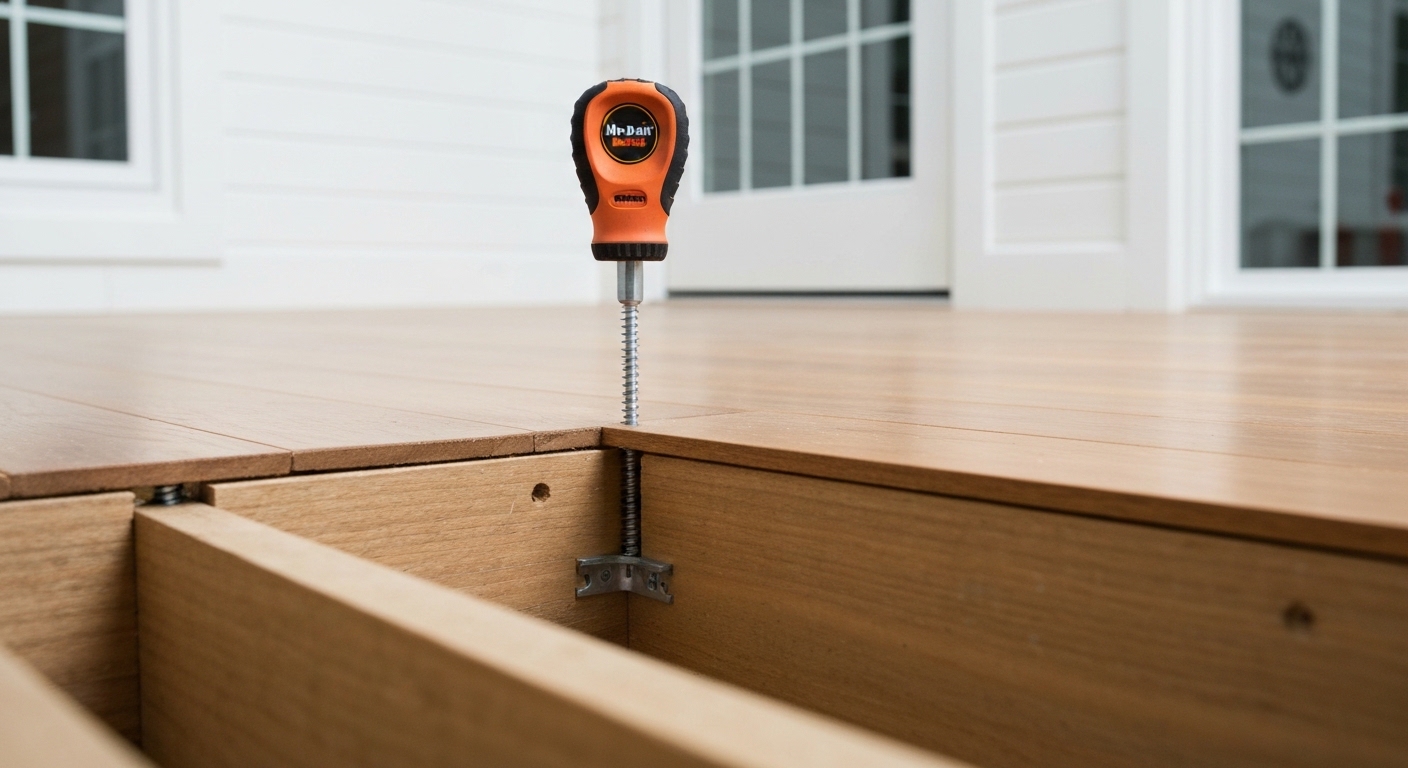
The kit comes with specialized screws that have a scored breakaway point near the head, plus a depth-control jig and an alignment tripod for carpet. You drive the screw down through the flooring and into the joist below, drawing the subfloor tight against the joist. Then you rock the screw back and forth at the scored point and the head snaps off cleanly below the floor surface. No visible fastener left behind.
Here is the catch: you have to find the joist. The kit includes a stud finder method for carpet (tapping while sliding the tripod) but on hardwood you need to find the joist first using a stud finder or by looking for the existing nail pattern in the floor. Once you have a joist located, screws go in fast.
How to Use It on Carpet
- Set the tripod on the squeaky spot. Screw goes through the guide hole in the center.
- Thread the screw in with an impact driver or cordless drill. It pulls itself down.
- When the screw head hits the tripod’s depth stop, keep turning. The head snaps off below the carpet.
- Lift the tripod. The screw is gone from view but still pulling the subfloor tight.
How to Use It on Hardwood
- Locate the joist with a stud finder. Mark it with a pencil dot on the floor.
- Use the included hardwood guide, which keeps the screw vertical.
- Drive the screw. When it bottoms out, rock the driver side to side until the head breaks off at the scored point.
- The tiny hole left behind can be filled with a wax pencil matched to the floor color.
I have fixed hundreds of squeaks this way. The only failure mode is missing the joist entirely, in which case the screw pulls on nothing and the squeak stays. Always find the joist first.
Method 2: Shims from Below (When You Have Basement Access)
Cost: Around $5 for a bundle of cedar shims and a tube of construction adhesive Time: 10-15 minutes per squeak Works on: Any floor with unfinished ceiling access below
If you can see the underside of the floor joists from your basement or crawl space, this is the cleanest fix for the “joist gap” cause. You are filling the gap between the joist and the subfloor so the subfloor cannot flex down anymore.
- Have a helper stand on the squeaky spot upstairs to press the subfloor down against the joist.
- Look up. You will see the joist and the subfloor above it. Find any gap between them near the squeak.
- Put a bead of construction adhesive on both sides of a cedar shim.
- Tap the shim gently into the gap with a hammer. Stop the moment you feel it hit the subfloor. Do not force it further — you can actually push the subfloor up and make things worse.
- Trim the sticking-out part of the shim with a utility knife once the adhesive cures.
This method is nearly invisible and almost always works on gap-type squeaks. It does not help if the squeak is caused by a loose nail, because you are not fastening anything — you are just supporting the subfloor.
Method 3: Screws Through the Subfloor (From Below, for Nail Pop and Loose Subfloor)
Cost: Around $8 for a box of 1-5/8-inch coarse-thread drywall screws Time: 15-30 minutes per squeak Works on: Any floor with basement access, any subfloor that has pulled away from joists
If you have basement access and the squeak is caused by the subfloor itself being loose on the joist, screws from below are the permanent fix. You are adding new fasteners that pull the subfloor tight against the joist without disturbing the flooring above.
- Have a helper stand on the spot.
- From below, push up on the subfloor with your hand to confirm it flexes. Locate the loosest area over the joist.
- Drill a pilot hole partway through the joist. Do not let the bit punch through the top of the subfloor — you do not want a drill bit emerging in the middle of your living room. The usual method is to stick a small tape flag on your bit at a depth equal to the joist thickness plus half the subfloor thickness. Stop when the flag hits wood.
- Drive a 1-5/8-inch screw through the joist and into the subfloor. The screw pulls the subfloor down tight. You should feel it grab and then cinch up solid.
- Test by stepping on the squeak. It should be gone.
The screw length matters. Too short and it will not grip the subfloor. Too long and it punches through the floor above. Measure your joist and subfloor before you start. A standard 1.5-inch joist plus 3/4-inch plywood subfloor is 2.25 inches, so a 1-5/8-inch screw leaves you about 5/8-inch of grab in the subfloor without risk of breaking through hardwood above. Adjust for your actual dimensions.
Method 4: Talc or Graphite Lubrication (Hardwood Floors Only)
Cost: Around $6 for a container of powdered graphite Time: 10 minutes Works on: Hardwood floors where boards rub against each other
Some squeaks are not subfloor squeaks at all. They are the hardwood boards themselves rubbing against each other at the tongue and groove joint. When the air is dry and the wood contracts, the joints loosen and creak against each other every time you step on them.
The fix is dead simple and temporary: lubricate the joint.
- Identify which specific board edge is squeaking by pressing on boards one at a time.
- Sprinkle powdered graphite or talcum powder along the joint.
- Work it into the gap with a rag or soft brush.
- Step on the board a few times to distribute the powder. Wipe off the excess.
Graphite is better than talc because it keeps working longer and does not clump with moisture. Talc is fine if it is what you have.
This is a band-aid, not a fix. It silences the squeak for weeks to months, and you will need to reapply when humidity changes. But it requires no tools, leaves no marks, and is perfect for renters or anyone who just wants quiet tonight.
Method 5: Tightening Subfloor Hardware from the Basement
Cost: Around $10 for a pack of 3-inch lag screws and washers Time: 30 minutes per spot Works on: Any floor where the squeak is caused by a joist that has pulled away from a beam or sill plate
Sometimes the problem is not the subfloor at all but the joist itself moving on its bearing point. You step on the floor and the entire joist drops a hair onto the sill plate or girder below, producing a squeak that travels along the whole length of the joist.
- From the basement, walk the length of the squeaky joist and look for gaps where the joist sits on the sill plate, a beam, or a girder.
- If you find a gap, use a shim and construction adhesive first (see Method 2).
- If the joist is loose against the subfloor along its whole span, drive 3-inch lag screws at an angle up through the joist into the subfloor every 16 inches along the length of the squeak. Pre-drill pilot holes to avoid splitting the joist.
- Lag screws with large washers provide much more clamping force than drywall screws and are the right choice for joist-to-subfloor work over longer spans.
This method is the most labor but delivers the most durable fix for a whole squeaky section of floor. If three or four squeaks are all on the same joist run, tightening the joist end-to-end often silences the entire row.
When to Call a Pro
Most floor squeaks are a DIY job. Call a pro when:
- The floor feels soft or sags when you step on it. That is structural damage, possibly rot or termite, and it needs a contractor or structural engineer to diagnose.
- The squeak is accompanied by visible gaps in the flooring above or cracks in the ceiling below. Something has shifted and is still moving.
- You have tried two methods and the squeak is back within a few weeks. There may be a bigger problem — a broken joist, sister joist needed, or a failing sill plate.
- The floor is bouncy or you can feel your furniture vibrate when someone walks past. That is a stiffness problem, not a squeak, and joists may need to be sistered by someone who knows what they are doing.
A good carpenter can usually fix a problem floor in half a day for $300-600. Rot or joist replacement starts around $1500 and goes up fast. Diagnose correctly before you spend.
Final Thoughts
Walk the room, mark every squeak, and decide which method fits before you start. If you can get under the floor, Method 3 (screws from below) is the cleanest permanent fix. If you cannot, the Squeak-No-More kit is the right call for almost everything. Shims and graphite are backup options for specific situations.
A squeaky floor is not a sign your house is falling apart. It is a sign the wood has settled in and loosened up over the years, which is what wood always does. Fix it once with the right method and it will stay quiet for decades.