Why Sharpness Matters More Than You Think
A sharp chisel is not a luxury. It is the difference between clean joinery and split, torn, bruised wood. A properly sharpened chisel will shave end grain off pine like it’s butter, pop a paper-thin curl from walnut, and pare a dovetail to a gnat’s whisker without crushing the fibers. A dull chisel mashes wood, slips, and forces you to push harder, which is exactly when you cut yourself.
Most beginners buy a chisel, open the plastic package, and start chopping mortises. Within an hour they’re frustrated, their joints are sloppy, and they think they need a better chisel. What they actually need is fifteen minutes of sharpening. Every chisel from the factory needs work out of the box. Even premium brands like Lie-Nielsen and Blue Spruce come ready to hone but not ready to use. Cheaper chisels need more work, sometimes a lot more.
The good news: sharpening is a skill you can learn in an afternoon. Once you have it, you will never again wonder why your joints look rough.
What You’ll Need
Stones: Water Stones, Diamond Plates, or Oil Stones
You have three main options. Any of them will get you razor sharp. Pick one system and stick with it.
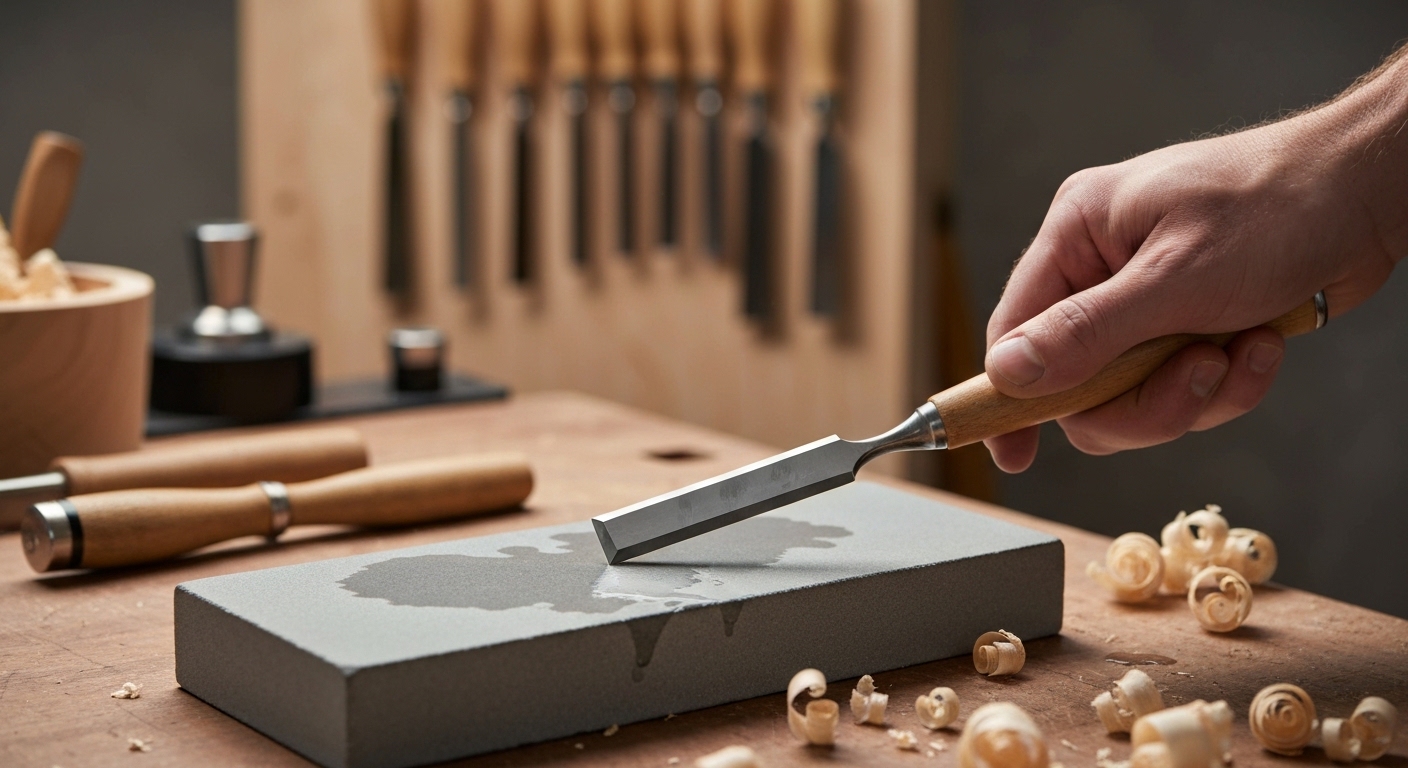
Water stones are what I use and what I recommend for most beginners. They cut fast, they give you immediate feedback, and the cheaper synthetic stones are under $40 apiece. You need three grits to go from dull to polished:
- 1000 grit for shaping and removing nicks
- 4000 or 5000 grit for honing
- 8000 grit for polishing
King, Shapton, and Naniwa are all excellent brands. For beginners, a King 1000/6000 combination stone at around $45 plus a separate 8000 grit finishing stone is the cheapest way to get a complete system.
Diamond plates do not wear, they never need flattening, and they work dry or with a little water. They cut a bit slower at the fine grits, but for beginners the lack of maintenance is a big plus. DMT and Trend make excellent plates. Budget around $60 to $80 for a coarse, fine, and extra-fine plate.
Oil stones like Arkansas stones are traditional, slow, and will last a lifetime. Skip them for now. They take longer to build a polished edge and the learning curve is steeper.
A Honing Guide
You can sharpen freehand, but a honing guide makes it almost impossible to get the angle wrong. The Veritas Mk II honing guide at around $70 is the best. A cheaper eclipse-style side-clamp guide works well for under $20 and is what most beginners should buy first.
A Leather Strop
A flat leather strop charged with green honing compound puts the final mirror polish on your edge. You can make one in five minutes from a scrap of hardwood and a strip of leather glued to it, or buy a ready-made strop for $15 to $25. Green chromium oxide compound is roughly 0.5 microns, finer than even an 8000 grit stone.
Flattening Plate
Water stones dish out as you use them. You need to keep them flat or you’ll grind hollows into your chisel backs. A DMT XXC diamond plate at around $90 serves as both a flattening plate and a coarse sharpening stone. If that’s out of budget, a sheet of 220 grit wet/dry sandpaper on a piece of plate glass works fine.
Step 1: Flatten the Back
This is the step everyone skips, and it is the most important one.
A chisel cuts with two surfaces: the bevel and the back. Both need to be dead flat and polished for the edge to be sharp. The back is flat when you buy it. It is not polished, and the first inch behind the edge often has grinding marks from the factory.
Put the chisel flat on your coarsest stone, back down, and work it in long strokes. Do not push down on the chisel shaft. Let the weight of your hands do the work. Keep the back absolutely flat against the stone. You will see scratches from the factory grinding slowly disappear and a mirror start to form, beginning at the edge.
Work through your grits: 1000, 4000 or 5000, then 8000. By the end, the first quarter inch behind the edge should be a mirror. It does not need to be mirror all the way up the chisel. Only the last inch matters because that is the only part that touches the wood near the edge.
This step can take 10 to 30 minutes on a new chisel. On a premium chisel that is mostly flat, it might be five minutes. Do it once. You never have to do it again.
Step 2: Set the Primary Bevel
The primary bevel on most bench chisels is ground at 25 degrees. Some people prefer 30. For general bench work, 25 is fine. For heavy chopping on mortises, 30 degrees gives you a stronger edge.
Put your chisel in the honing guide, set the angle to 25 degrees, and start on your 1000 grit stone. Work the bevel in long strokes, moving the full width of the stone to distribute wear. You are looking for two things:
- Even scratch pattern across the full width of the bevel
- A burr on the back of the chisel that you can feel with your thumbnail
The burr tells you the bevel has met the back. Once you feel a burr all the way across the edge, you’re done with 1000.
Step 3: The Honing Sequence
Now work up through the grits.
4000 or 5000 Grit
Move to the medium stone with the guide still locked at 25 degrees. Do not change the angle. Work until the 1000 grit scratches are gone and replaced with the finer pattern. Should take about 20 strokes. Check the back briefly on the medium stone to knock off any burr.
8000 Grit
On the finishing stone, do another 15 to 20 strokes. The bevel should now be nearly mirror. Flip the chisel and lay the back flat on the stone to remove the final burr. Do not lift the back even slightly. It must stay dead flat.
Step 4: Add a Secondary Bevel
Here is the trick that makes sharpening fast for the rest of your life. Once you’ve established the primary bevel, you will add a tiny secondary bevel at a slightly higher angle. The secondary bevel is maybe a millimeter wide and sharpened at 30 degrees.
Why bother? Because next time you sharpen, you only touch up that 1 mm secondary bevel instead of grinding the entire 25 degree bevel. A touch-up on the fine stone and the strop takes about two minutes. You can do it four or five times before the secondary bevel gets too wide and you need to reestablish the primary bevel.
To add the secondary bevel: bump your honing guide angle up by 5 degrees (so from 25 to 30), and do ten or fifteen strokes on the 8000 grit stone. That’s it.
Step 5: Strop the Edge
The strop is the final step and the one that takes you from sharp to scary sharp.
Charge your leather strop with a pass of green compound. Place the chisel bevel-down on the leather and pull it (never push) toward you, keeping the bevel flat against the leather. Do 10 passes on the bevel, then flip and do 10 passes on the back. Keep the back flat just like on the stones.
A stropped chisel should shave hair off your arm. It should slice newspaper cleanly. If you hold it edge-up to a light and look at the very edge, you should see no reflection at all. A dull edge reflects light because it has a flat surface at the tip. A sharp edge reflects nothing because it ends in a point too narrow to catch light.
Testing Sharpness
You have three good sharpness tests.
- Arm hair shave. A razor-sharp chisel will shave hair off your forearm with no pressure. This is the fastest test.
- End grain paring. Take a piece of pine end grain and try to pare a thin slice off with only hand pressure. If the chisel enters smoothly and leaves a glossy, uncrushed surface, it’s sharp.
- Paper slice. Hold a sheet of newspaper in one hand and push the chisel through it edge-first. A sharp chisel slices cleanly. A dull one tears.
If you fail all three, go back to your 4000 grit stone and do another ten strokes, then restrop.
Maintenance: Keeping the Edge
Sharp chisels go dull from three things: cutting wood, touching metal (like dropping them), and corrosion. To keep them sharp:
- Strop before each session. 30 seconds on the strop wakes the edge back up.
- Touch up on the 8000 grit stone every week or two if you use the chisel daily.
- Reestablish the secondary bevel on 4000 or 5000 grit when the 8000 touch-up stops cutting fast.
- Regrind the primary bevel on 1000 grit maybe twice a year, or after a chip or nick.
- Never store a chisel loose in a drawer. Use a leather roll or a wall rack. Edge contact with other metal is the fastest way to ruin a good edge.
Also: keep your water stones flat. Flatten them every time you sharpen, just a few strokes on the flattening plate. A dished stone will put a curve on your chisel bevel and you’ll have to fix it later.
Final Thoughts
Sharpening feels like a chore until you’ve done it for the first time on a dull chisel and suddenly the tool transforms in your hands. Then you understand why old-timers spend twenty minutes at the beginning of every day touching up their edges. A sharp tool is faster, safer, and produces better work, and the time you spend sharpening is not lost. It is the most efficient woodworking you can do, because a sharp edge eliminates twice as much future frustration.
Your first sharpening session will take 30 to 45 minutes. Your tenth will take five. Do not worry if your first attempt is imperfect. Keep going back to the stones, keep stropping, and within a month you will be able to produce a razor edge on autopilot. That is when the joinery starts to look right.