Before ordering a bigger toolbox, list the tools you actually need to store. Record their exact models, accessories and available shelf space. The useful result is a short list of fit requirements, not a shopping basket full of replacement tools.
Start with one drawer or shelf. Leave yourself a safe working area and a clear route through the room. You can inventory a small section without emptying the entire workshop onto the floor.
This is a planning guide, not a tested storage ranking or a certification that a particular tool is safe to use. The workbench photograph is a real contextual image, not our workshop or a kit offered for sale. Build Coded may earn from qualifying purchases through affiliate links in our linked buying guides.
Record the model before the category
“Cordless drill” is useful as a category but insufficient for ordering a battery, case or spare part. Copy the model from the tool label. Keep a separate line for batteries and the charger; an empty battery slot does not establish compatibility with another brand or range.
Use this record for each item:
Tool / accessory:
Manufacturer and exact model:
Battery system and battery model, if applicable:
Charger model and local power-supply requirement:
Accessories that must stay with it:
Stored length x width x height, with units:
Weight to account for:
Current location:
Last project / next planned project:
Condition question needing attention:
Decision: keep here / move / investigate / consider buying
Store purchase receipts and serial-number photos privately. Our receipts and manuals guide explains how to keep reference documents together.
Separate a missing accessory from a missing tool
If you already own a working drill but cannot find its compatible charger, a second drill may not solve the problem economically. First identify what you own, what is missing and what the next job actually requires.
| Inventory finding | Next decision |
|---|---|
| Tool present; charger unidentified | Confirm the exact compatible charger and power supply |
| Two similar tools | Record why each is kept before removing either |
| Tool has damage or uncertain condition | Set it aside for appropriate inspection; do not label it ready |
| Consumables are mixed together | Separate and label them before buying more |
Do not combine unidentified chemicals, transfer finishes into unlabelled containers or make repairs from an inventory checklist. Follow the relevant product instructions for storage, maintenance and disposal.
Measure the storage space as well as the tools
Record the clear shelf opening, door opening and route you will carry the box along. Measure the tool as it will actually be stored, including a fitted battery, handles and protected sharp edges where applicable. Record space needed to remove an item; a box that fits tightly under a shelf may still be awkward to open.
Hypothetical fit check: A shelf opening is 380 mm wide. A candidate box is 400 mm wide externally. It cannot fit that opening even if its interior is large enough for every tool. These numbers illustrate the check; they are not dimensions of the DeWalt box below.
Compare a box’s exterior with your shelf and its usable interior with your tools. They answer different questions. Check the manufacturer’s load limits and the weight you can reasonably carry rather than using volume as a proxy for portability.
A documented box example: DeWalt DWST17806
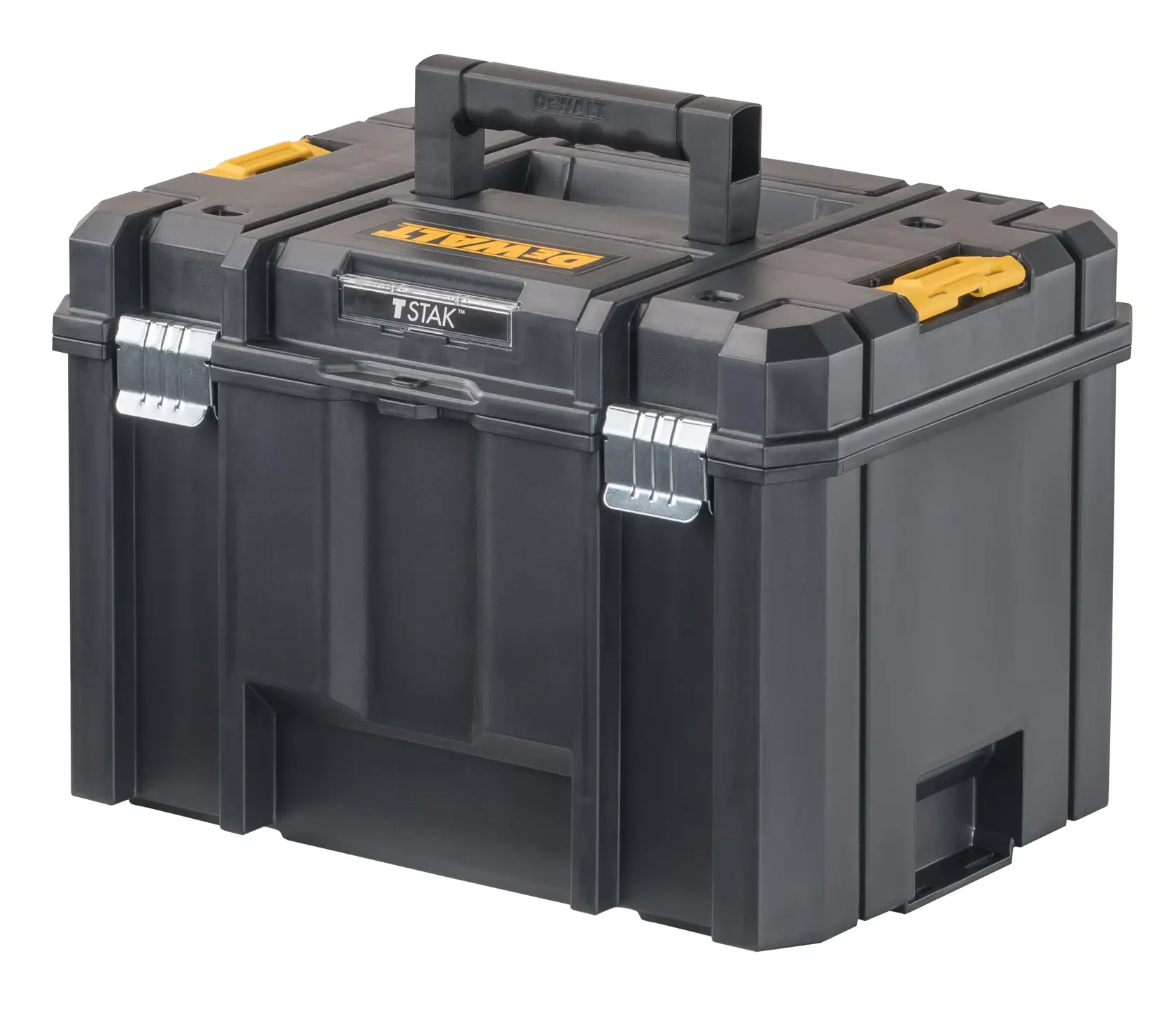
Manufacturer photo: DeWalt TSTAK VI DWST17806. The box is the product; the workbench tools in the hero photo are not included.
DeWalt describes this model as a deep box with a removable tray and side latches for joining TSTAK modules. Its interior-dimension reference lists 360 × 270 × 240 mm for DWST17806. Treat those as reference dimensions, not a guarantee of clearance beneath the tray or around a tool’s protruding parts.
Use your inventory to check the largest tool, charger, tray and shelf together. Do not assume that TSTAK connects directly to every other modular storage family or that a similar-looking box has the same weather rating. We have not performed a physical fit or load test.
Turn the inventory into one justified purchase
Write one sentence before shopping: “I need ___ because ___, and it must fit ___.” If you cannot complete it, finish the inventory first.
If the gap is storage, the toolbox and organizer guide compares storage types. If you truly need a drill, compare the documented drill packages and use the tool-only versus kit checklist to price the complete setup. Existing batteries and chargers can change which offer makes sense; a low tool-only price does not include missing accessories.
Update the record after that purchase and give the item a location. The next useful improvement may be a label or moving one tool, rather than another storage system.