Why Wood Type Matters
When you walk into a lumberyard for the first time, the prices don’t make sense. A 4/4 board of pine is $3 a board foot. The cherry next to it is $10. The walnut across the aisle is $15. The quartersawn white oak on the end rack is $22. They’re all the same thickness. They all came out of trees. Why the ten-fold difference in price?
The answer is that wood species behave completely differently under a plane, take finish differently, cost different amounts to grow and mill, and last different lengths of time in service. Understanding these differences is maybe the single most useful thing a beginner woodworker can learn, because it changes every decision you make from “which tree” to “which finish” to “how thick do I mill this stock”.
This guide covers the hardwood/softwood split, the Janka hardness scale that actually matters, and the eight species you’ll encounter in your first five years of woodworking. By the end you should know what to reach for when you’re planning your next project.
Hardwood vs Softwood: It’s Not About Hardness
First, the confusing part. “Hardwood” and “softwood” have almost nothing to do with how hard the wood is. They describe the type of tree.
Hardwoods come from angiosperms: broad-leafed, flowering trees that drop their leaves in the fall. Oak, maple, walnut, cherry, birch, poplar, ash, and mahogany are all hardwoods.
Softwoods come from gymnosperms: coniferous, needle-bearing trees like pine, cedar, spruce, fir, and hemlock. Their seeds are not enclosed in flowers or fruit.
That’s the whole distinction. It is botanical, not mechanical. Balsa wood, which is so soft you can dent it with your fingernail, is technically a hardwood because it comes from a flowering tree. Yew, which is harder than most oaks, is a softwood. Don’t memorize these exceptions. Just remember that the name tells you the tree, not the stiffness.
In practice, most hardwoods are harder than most softwoods, so the name isn’t a total lie. But what you actually care about is the Janka scale.
The Janka Hardness Scale
The Janka hardness test measures how much force (in pounds or newtons) is required to press a 0.444-inch steel ball halfway into a wood sample. Higher number means harder wood. It tells you how well a floor will resist dents, how tough a cutting board will hold up, and how much fight the wood will put up under a hand plane.
Here’s a rough range for common species:
- Balsa: around 100 lbf
- Eastern white pine: 380 lbf
- Poplar: 540 lbf
- Cherry: 950 lbf
- Soft maple: 950 lbf
- Black walnut: 1010 lbf
- Red oak: 1290 lbf
- White oak: 1350 lbf
- Hard maple: 1450 lbf
- Hickory: 1820 lbf
- Brazilian cherry (jatoba): 2350 lbf
For reference, a hardwood floor needs at least 1000 lbf to resist normal household wear. Pine floors work, but they dent. Maple and oak are the traditional sweet spot.
The 8 Species a Beginner Will Actually Use
1. Eastern White Pine
Type: Softwood Janka: ~380 lbf Cost: $3 to $5 per board foot Grain: Straight, even, pale yellow-white with occasional knots. Workability: Very easy to cut, plane, and sand. Will dent if you look at it wrong. Takes stain unevenly because the earlywood and latewood absorb pigment differently, so beginners often get blotchy results without a pre-stain conditioner. Use when: Practice projects, shop fixtures, painted furniture, farmhouse-style work, exterior trim.
Pine is the first wood every beginner should cut. It’s forgiving, cheap enough that mistakes don’t hurt, and widely available at every big-box store. The downside is that it’s soft enough to get beat up in daily use, and it looks like pine. Which either you love or you don’t.
2. Poplar
Type: Hardwood (though barely) Janka: ~540 lbf Cost: $4 to $6 per board foot Grain: Straight, bland, pale with green or purple streaks that turn brown in sunlight. Workability: Machines beautifully. Takes paint exceptionally well. Does not take stain well unless you condition it first. Use when: Painted cabinets, shop jigs, drawer boxes, anything that will be painted rather than stained.
Poplar is the secret weapon of the painted furniture world. It’s cheap, stable, and paints up like nothing else. If your project is going to be painted, do not overpay for maple or cherry. Buy poplar.
3. Red Oak
Type: Hardwood Janka: ~1290 lbf Cost: $5 to $8 per board foot Grain: Strongly pronounced, open-pored, pink to reddish brown. Workability: Easy to machine but the open pores want to tear out on interior corners. Takes stain evenly. Needs pore filler if you want a glassy finish. Use when: Hardwood floors, kitchen cabinets, sturdy furniture, anything that needs to look like oak.
Red oak is the American workhorse. For most of the 20th century it was in everything. The bold grain is polarizing, and it has fallen out of fashion in favor of white oak and walnut, which means prices are very reasonable. A beginner who wants to build a real hardwood piece cheaply should look here.
4. White Oak
Type: Hardwood Janka: ~1350 lbf Cost: $8 to $14 per board foot (quartersawn costs more) Grain: More muted than red oak, yellow-brown, with dramatic ray fleck when quartersawn. Workability: Machines well. Quartersawn is prized for its ray fleck. Extremely rot-resistant, which is why it is used for boats, whiskey barrels, and outdoor furniture. Use when: Mid-century modern pieces, outdoor furniture, Arts and Crafts furniture, anything that will see moisture.
White oak is having a moment. The quartersawn version with its shimmering ray fleck looks completely different from anything else, and it’s what most modern furniture makers reach for when they want a hardwood that photographs well.
5. Hard Maple
Type: Hardwood Janka: ~1450 lbf Cost: $6 to $10 per board foot Grain: Fine, even, pale cream to light tan. Workability: Hard on tools. Dulls blades quickly. Burns easily when routing, especially at curves. Takes stain poorly and unevenly. Beautiful under a clear finish. Use when: Butcher blocks, cutting boards, kitchen tools, bowling alleys, workbench tops, gym floors.
Hard maple is the cutting board wood. Its tight grain and hardness make it the right choice for surfaces that will see knives and water. It’s also traditional for workbench tops, because it resists dents from dropped tools. Do not stain it. Oil it or use a wiping varnish to show off the color.
6. Black Walnut
Type: Hardwood Janka: ~1010 lbf Cost: $12 to $18 per board foot Grain: Dramatic, chocolate brown with streaks of purple and gold. Workability: Machines beautifully. One of the nicest woods to plane, carve, and turn. Takes finish like a dream. The only downside is that the sapwood is pale cream and visually jarring, so you’ll want to either cut it away or embrace the contrast. Use when: Heirloom furniture, cutting boards, pens, knife handles, modern dining tables, anything meant to impress.
Walnut is the prestige wood of North America. A beginner who finishes their first walnut project becomes a walnut evangelist for life. If you can afford it, build something out of walnut at least once.
7. Cherry
Type: Hardwood Janka: ~950 lbf Cost: $8 to $12 per board foot Grain: Fine, subtle, starts pale pink and darkens over months and years into a deep reddish brown. Workability: Wonderful. Plans like butter. Sands to a glassy surface. Burns when routed if your feed rate is too slow. Use when: Shaker furniture, heirloom pieces, chests, fine cabinetry, anything where subtlety matters.
Cherry is the wood that rewards patience. Fresh off the planer it looks like blonde lumber. Set the piece in direct sunlight for a week and it deepens dramatically. A year later it is a color you cannot get out of a can of stain. Do not try to stain cherry. Let it age.
8. Birch
Type: Hardwood Janka: ~1260 lbf Cost: $5 to $8 per board foot Grain: Fine, even, pale with occasional figured sections. Workability: Machines well. Takes paint beautifully. Hard to stain evenly, similar to pine and maple. Often used as veneer on high-end plywood. Use when: Plywood cabinetry, painted interior work, toys, built-ins.
Birch is most commonly encountered as the face veneer on Baltic birch plywood, which is one of the finest plywoods made. Solid birch lumber is less common at retail but worth picking up when you find it.
Bonus: Western Red Cedar
Type: Softwood Janka: ~350 lbf Cost: $4 to $8 per board foot Grain: Pronounced, reddish brown, aromatic. Workability: Soft, splinters easily, light. Extremely rot-resistant. That famous cedar smell is a natural bug repellent. Use when: Outdoor furniture, deck railings, garden boxes, cedar-lined closets, sauna interiors.
Cedar is the softwood you use when you need weather resistance without the cost of white oak or teak. It’s too soft for furniture that takes wear, but for anything living outside, it lasts.
Cost Tiers at a Glance
- Under $6 per board foot: Pine, poplar, cedar, sometimes red oak on sale
- $6 to $10: Red oak, hard maple, cherry, birch
- $10 to $15: White oak, walnut, quartersawn oak
- $15 and up: Premium walnut, mahogany, exotic species
Hardwood prices have been rising steadily and will vary by region and availability. A small, family-run lumberyard is almost always cheaper than a big-box store, and they’ll have species the big stores don’t carry.
Grain Patterns and How They Matter
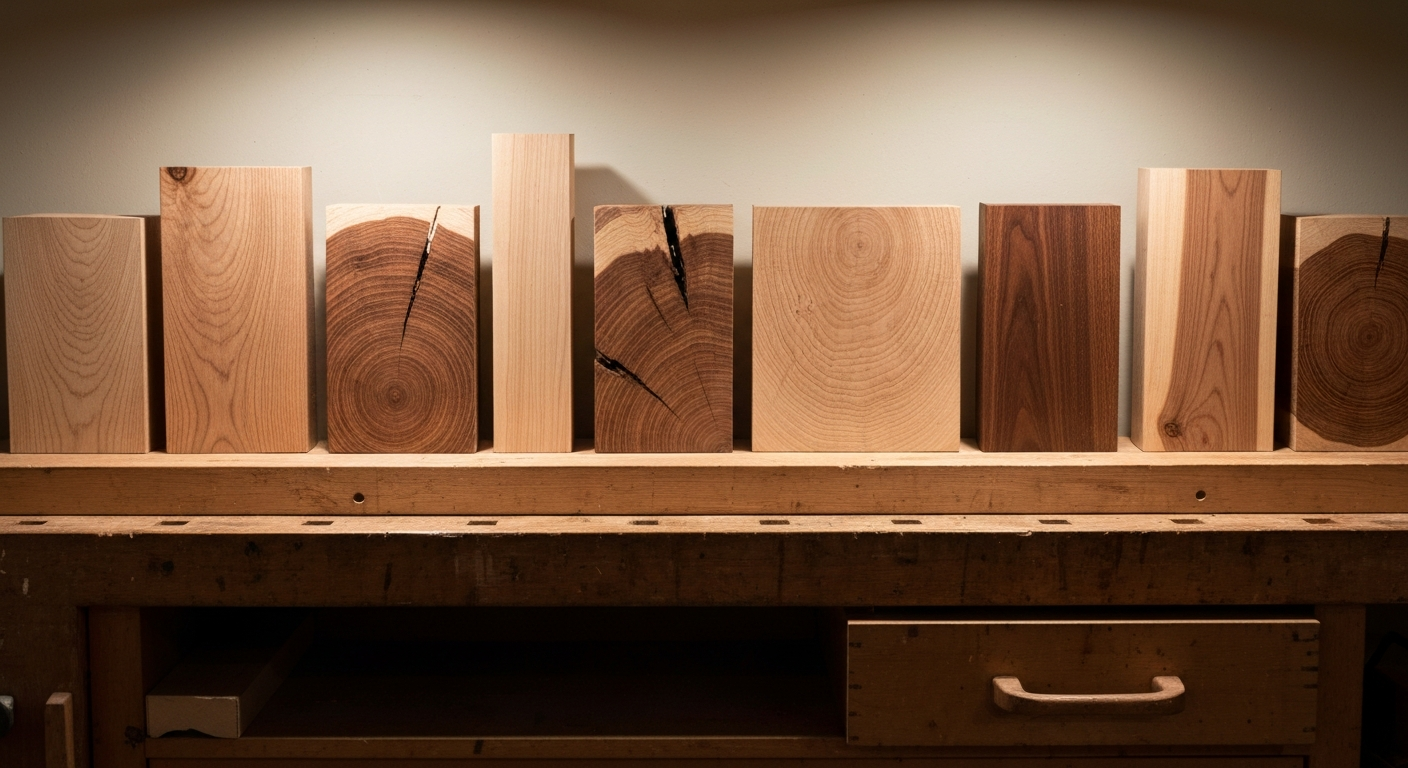
Wood grain runs in three planes: plainsawn (flat), quartersawn (vertical growth rings), and riftsawn (angled rings). Plainsawn is the cheapest and gives you those big cathedral grain patterns on the face. Quartersawn is more stable, more expensive, and in species like white oak produces the shimmering ray fleck that defines Craftsman furniture. Riftsawn falls in between.
For a beginner: plainsawn is fine for almost everything. Splurge on quartersawn only when the look matters or when you’re building something like a door frame where wood movement really matters.
Workability and Finishing Considerations
Open-grained woods (oak, ash, walnut) have visible pores that need to be filled or embraced. Closed-grained woods (maple, cherry, birch) have tight, almost invisible pores and finish to a smoother surface.
Woods that take stain well: oak, walnut, ash, mahogany. Woods that take stain poorly and need conditioner: pine, maple, cherry, birch, poplar. Woods you should never stain: walnut (it’s already gorgeous) and cherry (it will darken naturally into a better color than any stain can give you).
For oil finishes, walnut, cherry, and maple are all spectacular. For painted work, poplar and birch. For outdoor exposure, white oak, cedar, and teak.
Final Thoughts
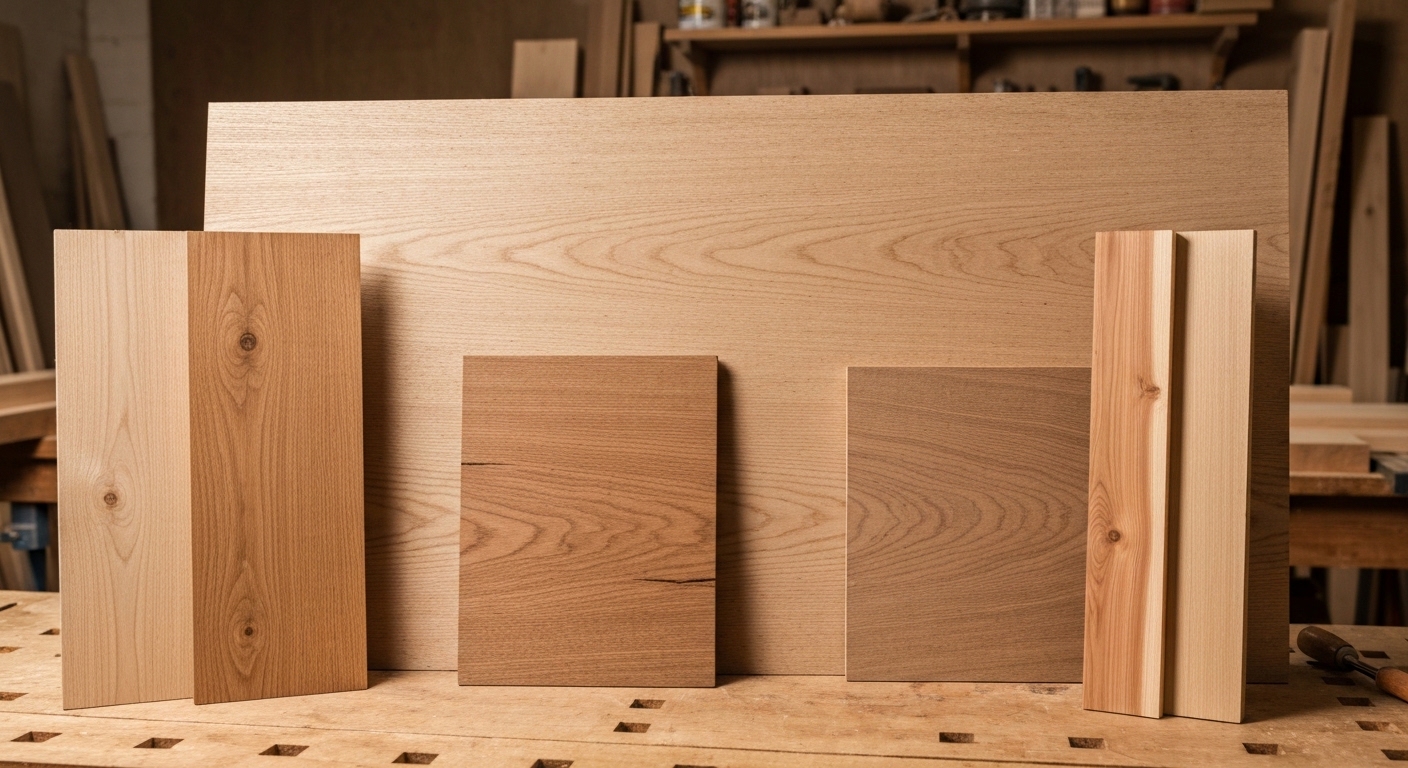
The fastest way to build intuition for wood species is to buy small samples of each and plane, sand, and finish them yourself. A lumberyard will usually sell you a one-foot length for a dollar or two. Go home, mill them all the same way, rub oil or wipe-on poly on half of each, and leave them side by side for a month. You’ll learn more from that single afternoon than from reading ten articles like this one.
Start your projects in pine. Graduate to poplar and oak. When you’re ready to build something that will outlive you, reach for walnut or cherry. The tree always tells you what it is, and the more time you spend with different species the faster you’ll hear what each one is saying.
Go Deeper
- Best Wood for Beginner Woodworking: 8 Species and When to Use Each — a hands-on breakdown of workability, cost, and what to actually build with each species
- DIY End-Grain Cutting Board: Step-by-Step Beginner Project — put maple and walnut to work in a first real project
- How to Build an Outdoor Planter Box: Cedar Planter Plans — cedar’s rot resistance in action for a beginner-friendly outdoor build
- 7 Cedar Raised Garden Bed Plans (Free PDF Cut Lists) — more cedar outdoor builds at every skill level
- Chicken Coop Plans: 5 Designs from $75 to $600 — structural outdoor builds using pine, cedar, and dimensional lumber
- Beginner Woodworking Joints Guide — once you know your species, learn how to connect them properly
- Best Beginner Woodworking Tools — the hand and power tools you need to mill and shape any of the species above